
The Children Before Us: Recovering Their Memories and Raising Their Voices


Today’s political controversy over the education of Texas’ children is as intricate and contentious as it has been since 1845. With the myriads of news and media outlets, we are routinely challenged with sorting out the facts from opinions. But to make sense of the arguments and tasks at hand, we can only infer by conducting a deep dive to examine the historically significant developments from the past to the present. Indeed, we often lose sight of the importance of a historical perspective when we try to figure out the endless reverberations of political discourse without a comparative reference point. Our democratic standards as a nation are constantly shifting, probing our inner instincts to understand the invisible ramifications of critical happenings in real time. History provides us with a framework of different perspectives and interpretations that are essential in understanding today’s complicated political debates.  

Recently, Texas legislators are poised to decide, yet again, on the fate of public education. A few years ago, political leaders touted public education as one of the most enduring and fundamental educational institutions in Texas. Indeed, public education was one of a few institutions that had the equal support of most Texans. However, today, the debate over how to fund state education is divided between those that support public education and those that support a voucher system to fund private schools. The latter position would reduce the amount of funds that are generally partitioned for public education. The voucher system is necessary, the proponents argue, because the public schools are not adequately serving their needs. It’s incumbent upon us to know and understand the historical nature of our public education institutions so we may have well-informed opinions on this matter.  

In this article, I highlight key events that merge the past with the present to comprehend the issues, problems, and thus, offer new and innovative possibilities that can truly make a difference. I analyze racial conflicts, court cases and other impactful events that have contributed to the current system of the state’s public education. My focus is on how children of color experienced school in the face of extreme negative social conditions in an era that was greatly impacted by the economic crisis of the state and country. During a most stressful period of early development of Texas as a State, some of the major policies and laws promulgated were not in the best interest of these children. The newly formed populous couldn’t be more starkly different from one another, but they all held a common vision created from the promise of a prosperous future. Opportunities to prosper were afforded, then, and now, to mostly the White, Anglo-Saxon groups, but were systematically diminished for the Hispanic and Black communities. The most directly affected were the children whom nonetheless persevered. They are the unsung heroes of our past whose notable courage and perseverance cannot be overlooked.

Background Information: Public Education in Texas

To begin to put this discourse into context, I developed a table, attached at the end of this article (best supported on desktop computers): (Table 1 The Chronology of Significant Events Related to the Education of Latino Students in Texas). This table includes a few notes of importance that relate to Texas history, the Civil War, and the Reconstruction Amendments of 1868 – all of which bear relevance to the establishments of the state’s educational institutions. The Fourteenth Amendment is particularly important in the related research as it played a major role in the outcomes of multiple court cases. The Fourteenth Amendment includes the following statements:

All persons born or naturalized in the United States, and subject to the jurisdiction thereof, are citizens of the United States and of the State wherein they reside. No State shall make or enforce any law which shall abridge the privileges or immunities of citizens of the United States; nor shall any State deprive any person of life, liberty, or property, without due process of law; nor deny to any person within its jurisdiction the equal protection of the laws.

The Article VII, Section 7 of the 1876 U.S. Constitution is well-known for its provision to create separate schools for “the white and colored children, and impartial provision should be made for both.” This was at the core of the “separate but equal doctrine” that was used to justify racial segregation, although it should be noted that the ‘impartial provision” was disregarded, perhaps because this was not the intended goal. 

The South and the Southwest U.S. were greatly impacted by the Plessy vs. Ferguson court case of 1896. The Jim Crow laws were used to racially discriminate against both Texas Hispanics and African Americans and in similar ways. Many of us recall this happening in our hometowns as recent as the 1960s. The Isis movie theatre in my hometown of Fort Worth, for example, required Hispanics and Blacks to enter the theater using a side door to the balcony since we weren’t allowed on the main floor.  

During and after the Civil War, a period of intense reconstruction was evident, and in Texas, the agricultural economy was at its initial peak stages. Many White Texans that had migrated from the South readily transferred their racial, prejudicial views of African American laborers to the Mexican workers, and the newcomers from the Midwest had similar derogatory perceptions toward the Mexicans, akin to how they felt toward the of Native Americans. 
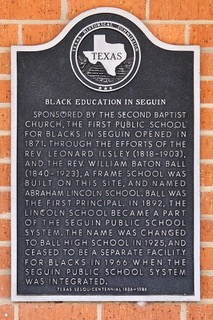

(1986) Sponsored by the Second Baptist Church, the first public school for blacks in Seguin opened in 1871. Through the efforts of the Rev. Leonard Ilsley (1818-1903), and the Rev. William Baton Ball (1840-1923), a frame school was built on this site, and named Abraham Lincoln School. Ball was the first principal. In 1892, the Lincoln School became a part of the Seguin Public School System. The name was changed to Ball High School in 1925, and ceased to be separate facility for blacks in 1966 when the Seguin Public School System was integrated. Click here for more information.


The farm settlers were dependent on slavery until it became completely prohibited by law. Then, they turned their attention to Mexican laborers that they could hire for very low wages. There was a strong resistance against educating the worker’s children since this was counterproductive to their business, and the children were not allowed to commingle with each other. 

By the time the first “Mexican school” was opened in 1903 in Seguin, Texas, the Jim Crow law based on the “separate but equal doctrine” had taken root. 
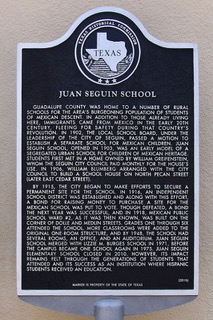

Guadalupe County was home to a number of rural schools for the area’s burgeoning population of students of Mexican descent. In addition to those already living here, immigrants came from Mexico in the early 20th century, fleeing for safety during that country’s revolution. In 1902, the local school board, under the leadership of the city of Seguin, passed a motion to establish a separate school for Mexican children. Juan Seguin School, opened in 1903, was an early model of a segregated urban school for children of Mexican heritage. Students first met in a home owned by William Greifenstein, whom the Seguin City Council paid monthly for the house’s use. In 1906, William Blumberg arranged with the city council to build a school house on North Pecan Street (later East Cedar Street). Click here for more information.


Historians point out that at least 18 school districts in South Texas had segregated schools in the 1920s. These were: Lower Valley/Valley: Edinburg, Harlingen, San Benito; McAllen, Mercedes, Mission, PSJA; Gulf Coast: Raymondville, Kingsville, Robstown, Kenedy, Taft; Winter Garden: Crystal City, Carrizo Springs, Palm, Valley Wells, Asherton, Frio City. Many other similarly segregated schools existed but were not officially documented. Between 1942 and 43, segregated schools were functional in 122 Texas school districts in 59 counties. Other states such as California and New Mexico in the Southwest documented similar patterns of racially segregated schools in racially segregated communities as well as throughout public establishments. 

This was the segregated school era that characterized education throughout Texas, New Mexico, and California. Scholars in California like David G. Garcia, noted that in the 1920’s 80% of school systems across the Southwest United States experienced a segregated order. Other credible historical data indicate that 90% of schools in South Texas alone were segregated. 


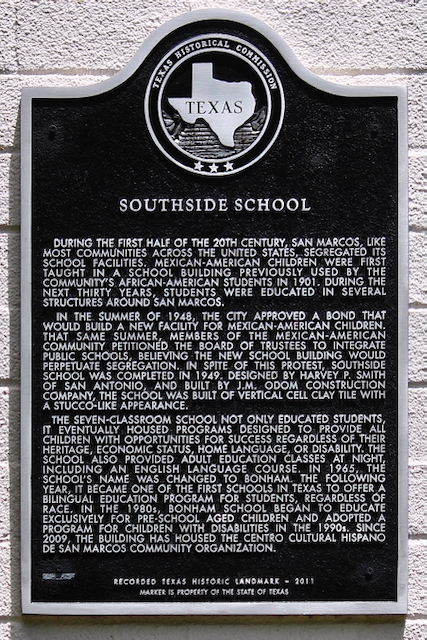
During the first half of the 20th century, San Marcos, like most communities across the United States, segregated its school facilities. Mexican-American children were first taught in a school building previously used by the community’s African-American students in 1901. During the next thirty years, students were educated in several structures around San Marcos.
     In the summer of 1948, the city approved a bond that would build a new facility for Mexican-American children. That same summer, members of the Mexican-American community petitioned the board of trustees to integrate public schools, believing the new school building would perpetuate segregation. In spite of this protest, Southside School was completed in 1949. Designed by Harvey P. Smith of San Antonio, and built by J.M. Odom construction company, the school was built of vertical cell clay tile with a stucco-like appearance. For more information click here.

Segregation, in and of itself, served as an educational experience. Strong, intense negative perceptions directed toward a group of people unveiled the harsh reality that is well-recognized today as racism, and Mexican students were at the center of the crossfire. The following remarks are based on the research data collected by scholars and historians:

  • Insults and disparaging remarks. School authorities, including administrators, school board members, and teachers were quoted the following in their efforts to explain why segregation was essential: the Mexican children had “mental retardation, language problems, poor hygiene, failure to appreciate education, and possessed an inherent inferiority.” (Montejano, p. 192)
  • Racial Inferiority: White children were taught by their family members that Mexicans were “impure and to be kept in their place.” (p. 230) 
  • The “White” view that Mexicans should recognize their own inferiority and to accept segregation as a means by which to maintain order. (p. 230) 
  • Children understood that segregation meant that White children were superior, and Mexicans were inferior. The power was controlled by the White authority, ensuring their superiority status, and the inequality inherent in social reproduction. (p. 230)
  • The class of farmers and growers who opposed educating Mexican children believed that education, including learning English, would steer them away from labor. They needed a class of people that would accept such difficult jobs at very meager wages. (p. 192)
  • The “Mexican” schools were substandard, physically inferior. The children used textbooks and materials discarded by the White children. School Boards regularly provided the overwhelming share of the funds to the White schools. (p. 192)

A summary of life in a segregated school is described succinctly by the author David G. Garcia’s vivid account of what he terms mundane racism in his study of a California school district: 

… the systematic subordination of Mexicans enacted as a commonplace, ordinary way of conducting business within and beyond schools. I utilize the term “mundane racism” to more precisely account for the way racism took place in Oxnard, and to understand the system of prejudice and discrimination against Mexicans designed to reproduce inequality as a routine matter of course. (p. 5)

Court Cases Before 1954

One of the earliest court cases in Texas that addressed the inequality of racial segregation was the Del Rio vs. Salvatierra case of 1930. Mr. Salvatierra was a concerned parent whose children attended a segregated “Mexican” school that had systematically been neglected in favor of the schools attended by White students. The court argued that a blatant inequality existed, while the defendants denied racial segregation in their schools, claiming that the Mexican students were “White” and not African American. Indeed, this was a weak argument and did not justify the existence of inferior schooling for Mexican students. However, the case was appealed, and a rehearing was denied.  

Other similar court cases brought forth by plaintiffs demanding a halt to racial segregation were also quasi successful. In the cases filed against school districts in 1947, Hernandez vs. Driscoll and Delgado vs. Bastrop, the courts argued favorably for the plaintiffs. However, because of the school districts’ continuous challenges to the rulings, the outcomes were shortchanged.

In California, the 1947 Mendez vs. Westminster court case was particularly successful for a couple of reasons. First, the plaintiffs won on appeal to the Ninth Circuit Court that ruled against segregation, declaring it as unconstitutional under the 14th Amendment. Secondly, the court case preceded the landmark federal case of Brown vs. Board of Education in 1954 in which similar arguments were used, and specific legal team members such as Thurgood Marshall, who later became a Supreme Court Justice, had participated in the case’s preparation.

Court Cases After 1954

The Brown vs. Board of Education of 1954 ruling had a significant effect on eliminating segregation in public schools. The court declared that the separate but equal doctrine was unconstitutional under the Equal Protection Clause of the 14th Amendment.

The Civil Rights Act of 1964 added a crucial argument to court cases that sought a defense mechanism against practices of discrimination in schools and beyond. 

At the federal level, the 1968 Bilingual Education Act provided specific funding for English Language Learners. In the 1981 court case of United States vs. State of Texas, the court ruled that the state educational agency “had failed to help ELLs overcome language barriers under the Equal Educational Opportunities Act (EEOA).” In response, the agency expanded the bilingual education programs to grades K-6 and ESL programs to include middle and high school students.

Although not entirely successful, the court cases have been instrumental in the efforts to improve the quality of education for all children, specifically for the most vulnerable students (the students of color, students with disabilities, etc.). In almost every professional segment of a society there exists a growing consensus that racial segregation, in its widespread and deeply embedded scale, was a malicious hindrance, thwarting well-intended educational improvement efforts in Texas and elsewhere. Indeed, in a comparative perspective, while Texans were entangled in the inferior realms of racial segregation, during the same period and in other parts of the world there were: Einstein who invented the theory of relativity, the great medical and science advancements, the empirical designs in math and physics, etc. Many would agree that the lesson learned, albeit as antiquated and uncomplicated as it may appear, is that the quantity and quality of our accomplishments depend on how much we’re willing to harness our capabilities and resources and focus our work on solving relevant problems or issues that affect all of us. 

Symbolic Violence Replaces Hard Violence

In today’s modern society, many would argue that most of the blatant discriminatory practices of the past are non-existent, at least on a wider scale. Still and all, children are unjustly treated in schools because of their racial and/or language identity. As I point out in the article Blaming the Children, many important state agency’s policies that guide curriculum programs and practices as well as evaluation procedures are implemented with serious negative consequences. Additionally, there is a paucity of mechanisms to properly monitor programs and policies, thus, ensuring their utmost effectiveness. I also discuss the option of school reform efforts that can address the achievement gaps and overall improve the educational programs for these students.  See Becoming Bilingual article.

A re-adjustment of our understandings of the past events is necessary to improve our capabilities as change agents. We agree that among the most significant social factors poverty and its devastating consequences were major causal factors. Indeed, we can identify Oscar Lewis’ explanation of his notions of the culture of poverty, which he introduced in the 1950s and 60s, when we examine the inflammatory inferior remarks aimed at the students, many of whom lived in extreme poverty conditions affecting their health and welfare. However, the culture of poverty explanation focuses on superficial or surface-level behaviors, obfuscating the real inferior social conditions that existed. Due to the work of scholars in the fields of the social sciences and education, an efficacious framework was developed, and its usefulness is currently applicable to expand upon this understanding, which I discuss in the following paragraphs.

The French sociologist, Pierre Bourdieu (1930-2002), was one of the key contributors to the concept of symbolic violence. A type of non-physical violence, symbolic violence aims to engage others in the reinforcement of the status quo. Rather than resorting to physical, brute violence to compel compliance from subordinated individuals to the rules of domination, in symbolic violence the perpetrators, who hold and enforce their power, employ alternative means that are nuanced and subtle. In effect, the non-physical violence is an unconscious reinforcement of dominance whereby the subordinates are unaware of the actions perpetrated against them since they are presumably following the established rules or laws.  Essentially, the dominant social group promotes self-aggrandizing norms to legitimize their authority and further suppress lower classes, thereby reducing opportunities of social equality.

Bourdieu and the insights of other key contributors introduced a novel and intriguing approach to scholarship in the social sciences. Their research provided deep insights into how power and dominance in social relations impact our democratic ideals and the rule of law.

Concluding Remarks

Researchers relied on analytical tools to critique the acts of symbolic violence that were perpetrated against the Mexican and African American students, such as racial segregation and racial bullying. To endure the constant and systematic threats against them, these students had to learn to fend for themselves and become self-reliant and resilient. Their acts of courage are a testimony of their tenacity and strength in the belief that as Texans they have the same rights as others to obtain access to a quality, equitable education. Their impactful memory serves as a reminder of our work as educators and stakeholders, and the need to continue in securing the optimal opportunities for educational and social equality. 


Please visit this article and others in the Bilingual Fronteras website.


Research Notes

Please note that the word Mexican is used interchangeably with Hispanic and Latino, and that in the instance where I use Mexican or Mexican American it is for the reason to remain constant with the pertinent resource(s). I use the term “White” to refer to individuals with Anglo-Saxon heritage. This term is used in the research literature.

Book sources:

  • Bourdieu, P. (1984). Distinction: A Social Critique of the Judgement of Taste. London: Routledge, 1984.
  • Lewis, Oscar. (1961). The Children of Sánchez: Autobiography of a Mexican Family. Random House, Inc. (Film, 1979)
  • Montejano, D. (1987). Anglos and Mexicans in the Making of Texas, 1836 – 1986. Austin: University of Texas Press.
  • Taylor, P. S. (1934). An American-Mexican frontier: Nueces county Texas. Chapel Hill: University of North Carolina.

Article:

  • García, D. G. (2018). “Strategies of segregation: Race, residence, and the struggle for educational equality.” Berkeley: University of California Press.

Internet Sources:


Table 1 Chronology of Significant Events Related to the Education of Hispanic Students in Texas


1836

1845

1846 -1848


1861 -1865
Significant Historical Notes:
Texas declared its independence from Mexico.
 
Texas annexed as the 28th state of the Union. 
 
Invasion of Mexico by the US army. Treaty of Guadalupe Hidalgo signed in 1848. 
 
Civil War – Lincoln’s Emancipation Proclamation
1868 –

Reconstruction Amendments
13th Amendment: Neither slavery nor involuntary servitude …
14th Amendment: All persons born or naturalized in the United States, and subject to the jurisdiction thereof, are citizens of the United States and of the State wherein they reside. No State shall make or enforce any law which shall abridge the privileges or immunities of citizens of the United States; nor shall any State deprive any person of life, liberty, or property, without due process of law; nor deny to any person within its jurisdiction the equal protection of the laws.
15th Amendment: The right of citizens of the United States to vote shall not be denied or abridged by the United States or by any State on account of race, color, or previous condition of servitude.
1876Article VII, Section 7, of the Constitution of 1876: Separate schools shall be provided for the white and colored children, and impartial provision shall be made for both.
1896Legal and Policy Cases:
 
Plessy vs. Ferguson: the Court sustained the constitutionality of Louisiana’s Jim Crow law.       
1902De facto segregation fact: First “Mexican” school built in Seguin, TX.
1920sSegregated Schools: Lower Valley/Valley: Edinburg, Harlingen, San Benito; McAllen, Mercedes, Mission, PSJA; Gulf Coast: Raymondville, Kingsville, Robstown, Kenedy, Taft; Winter Garden: Crystal City, Carrizo Springs, Palm, Valley Wells, Asherton, Frio City; many others not officially documented.
1942 -1943De facto segregation: Segregated schools were functional in 122 districts in 59 counties in Texas. According to various historical data sources, 80% to 90% of school systems throughout the Southwest United States sustained segregated schools.
1930Del Rio vs. Salvatierra – Jesus Salvatierra, parent, Mexican students deprived of the benefits afforded “other White races,”On May 15, 1930 District Judge Joseph Jones heard the case, ruled in Salvatierra’s favor, and granted an injunction. Texas court of appeals ruled the injunction was voided and rehearing was denied. (1971)
1947Mendez vs. Westminster  – This case challenged the segregation of Mexican American students in California schools. Mexican Americans were often labeled as “white” in official census categories yet were segregated into separate and unequal schools. Plaintiffs provided evidence that school districts explicitly created segregation. Judge McCormick  ruled in favor of plaintiffs. The school districts appealed claiming that the federal courts did not have jurisdiction over education. However, the Ninth Circuit ruled that such segregation was unconstitutional under the 14th Amendment. (Seven years later, 1954 Brown vs. Board of Education) 
1948Hernandez vs. Driscoll – The court found the Driscoll grouping of separate classes arbitrary and unreasonable, as it was directed against all children of Mexican origin as a class, and ordered the practice halted. Although the decision prohibited segregation of Mexican-American students in public schools, however, the system did not change radically, and in fact subsequent challenges became necessary.

Delgado vs. Bastrop ISD – The court ruled that maintaining separate schools for Mexican descent children violated the Fourteenth Amendment of the United States Constitution. Nevertheless, failure to enforce this ruling resulted in continued legal challenges through the 1950s and 1960s; arguments first presented in the Salvatierra case were heard as late as 1971 in Cisneros v. Corpus Christi ISD.
1954Brown vs. Board of Education. This landmark Supreme Court case struck down racial segregation in public schools (“separate but equal doctrine”) as unconstitutional under the Equal Protection Clause of the 14th Amendment.
1964Civil Rights Act – prohibits discrimination on the basis of race, color, religion, sex or national origin. Provisions of this civil rights act forbade discrimination on the basis of sex, as well as, race in hiring, promoting, and firing. The Act prohibited discrimination in public accommodations and federally funded programs. It also strengthened the enforcement of voting rights and the desegregation of schools.
1968, 1975Cisneros vs. Corpus Christi ISD – Judge Woodrow Seals found in 1975 that the school board consciously fostered a system that perpetuated traditional segregation. Judge Seals cited the “other White” argument as adjacent proof of segregation, but relied primarily on the application of unconstitutional segregation of Mexican Americans as an identifiable minority group based on physical, cultural, religious, and linguistic distinctions.
1968The Bilingual Education Act, Title VII of the Elementary and Secondary Education Act of 1968: Establishes federal policy for bilingual education for “economically disadvantaged language minority students” that allocates funds for innovative programs, and recognizes the unique educational disadvantages faced by non-English speaking students.
1971United States vs. State of Texas – The federal court ordered the San Felipe Del Rio CISD to desegregate and provide equal educational opportunities to all students – based on 14th amendment and the Civil Rights Act of 1964. As a result of the lawsuit, the federal court came down with a court order, Civil Action 5281, which eliminates discrimination on grounds of race, color, or national origin in Texas public and charter schools.
1973Keyes vs. School District No.1 – This federal Supreme Court case examined de facto/de jure segregation in Denver, Colorado, where no explicit laws enforced school segregation. Instead, plaintiffs argued that school district policies (gerrymandering attendance zones, school siting, etc.) had the intent and effect of racially segregating schools. (Similar to Cisneros vs. Corpus Christi 1971.) It is one of the first major Supreme Court cases to include Latino plaintiffs and concerns about their treatment under segregation.
1974Lau vs. Nichols – Supreme Court case that ruled that schools must provide language instruction to students with limited English proficiency. The court’s decision established that this lack of instruction violated the Civil Rights Act of 1964. 
1974Serna vs. Portales (NM) – This was the first case to raise the issue of bilingual education outside of the context of desegregation. It was argued under Title VI of the Civil Rights Act of 1964, which prohibits discrimination on the basis of “race, color, or national origin” in any program that receives federal funding. The court found the school’s program for these students to be inadequate. Upon appeal, the 10th Circuit Court of Appeals decided in favor of the plaintiffs in 1974, just six months after Lau.
1981United States v State of Texas (Texas Education Agency) – the District Court found that the State had failed to help ELLs overcome language barriers under the Equal Educational Opportunities Act (EEOA). While the case was on appeal, Texas passed a law expanding bilingual education to grades K-6 and providing for English as a Second Language (ESL) programs for middle and high schools.
1981Castañeda vs. Pickard – The case originated in Texas, where plaintiffs charged that the Raymondville Independent School District was failing to address the needs of ELL students as mandated by the EEOA. The federal court ignored the old assumption that Lau and the EEOA mandated bilingual education. A major outcome of this case is a three-pronged test to determine whether schools are taking “appropriate action” to address the needs of ELLs as required by the EEOA.
1981Plyler vs. Doe – Under the Fourteenth Amendment of the U.S. Constitution, the state does not have the right to deny a free public education to undocumented immigrant children.
1984, 1995Edgewood ISD vs. Kirby – The Edgewood lawsuit occurred after almost a decade of legal inertia on public school finance following the Rodríguez v. San Antonio ISD case of 1971, which asked the courts to address unfairness in public school aid. Rodríguez plaintiffs ultimately lost in the United States Supreme Court in 1973.
1836


1837


1845

1846 -1848

Historical Notes of Texas, U.S., & México:

1810 – 1821 Mexico gains independence from Spain after 300 years of Spanish colonial rule.

Texas declares independence from Mexico, known as the Republic of Texas. The declaration signed during the Texas Revolution which began in October 1835.

The United States government recognizes Texas’ independence.

Texas was annexed by the United States as the 28th state of the Union

Invasion of Mexico by the US army. Treaty of Guadalupe Hidalgo, 1848. U.S. paid México $15 million for territory.


Please visit this article and others on Bilingual Fronteras website.

Becoming Bilingual: What Schools Finally Got Right About Language Learning


Bilingualism encompasses an examination of both language and culture. To fully appreciate the remarkable strides made in the fields of linguistics and anthropology over the past century, it is helpful to review some key milestones. In the 1920s, the prevailing view of how children acquired language centered primarily on imitation and repetition, with only limited attention given to the role of context and social interaction. Language learning was often equated with broader patterns of behavioral development, and it was generally assumed that children would naturally acquire their first language under normal circumstances. However, the introduction of Noam Chomsky’s revolutionary linguistic theories in the 1950s marked a paradigm shift that transformed the study of linguistics. This shift, often referred to as a linguistic revolution, dramatically expanded the scope and depth of inquiry into language acquisition.

At the core of this new perspective was the idea that understanding how language develops requires examining not only contextual and social interactions but also the interplay between language production, cognitive processes, and verbal expression. In essence, language was no longer seen solely as a learned behavior but as a profoundly integrated aspect of human thought and cultural existence. Since this groundbreaking shift, researchers and practitioners have produced a wealth of scholarly work, thus, deepening our understanding of language learning, and shaping approaches to support children’s linguistic and academic development in both school and at home. This ongoing exploration continues to influence how we nurture language acquisition in young learners, highlighting the dynamic interplay between culture, cognition, and communication.

Cultural anthropology was similarly transformed by the groundbreaking work of trailblazing scholars who developed broad, conceptual frameworks for understanding culture. One of the most significant shifts in the field was the evolution of the perceptual lens through which cultures were studied. Early anthropological approaches often relied on ethnocentric assumptions, i.e., framing non-Western societies through a lens of superiority and inferiority. This reductionist perspective not only perpetuated biases but also yielded a narrow and distorted understanding of cultural diversity.

In contrast, contemporary anthropology has embraced a more open-ended, relativistic approach that prioritizes understanding cultures on their own terms. This perspective values the complexities and unique contexts of cultural practices, fostering a deeper and more nuanced comprehension. Recent anthropological studies have drawn from diverse viewpoints—incorporating elements of globalization, intersectionality, and post-colonial theory—to adapt and expand the concept of culture as a dynamic, fluid, and ever-evolving process.

These advancements hold profound implications for educators and practitioners, particularly in multicultural and linguistically diverse classrooms. By recognizing culture as both adaptive and relational, teachers can adopt more inclusive and culturally responsive approaches to education. This allows for the integration of students’ unique cultural backgrounds into pedagogy, creating learning environments where diversity is seen as an asset rather than a challenge. A modern anthropological lens, therefore, equips educators to not only educate but also celebrate the multiplicity of cultural perspectives, ultimately fostering equity and understanding in their interactions with students.

The contributions of numerous scholars, including Jim Cummins (as detailed in my article), have profoundly shaped the field of bilingual education, influencing both its theoretical foundations and practical applications. Over time, debates surrounding bilingual education became deeply intertwined with political and social discourses, often reflecting broader tensions around issues like identity, assimilation, and equity. Despite these contentious debates, a growing body of research and the experiences of practitioners—particularly bilingual educators working in diverse classrooms—have reinforced the value of bilingualism in academic development.

One of the most compelling insights to emerge from this body of work is that children learning English as their second language (ELLs) do not need to abandon their primary language or cultural identity to achieve academic success. On the contrary, research indicates that the development of a child’s primary language plays a critical role in facilitating the acquisition of English as a second language. This “additive bilingualism” approach underscores the importance of nurturing a student’s first language, not only as a means of linguistic transfer but also to honor their cultural heritage and bolster their overall cognitive development. In practice, this has led to a richer understanding of how bilingual education can serve as a bridge between home and school, fostering both academic achievement and cultural affirmation.

Our current understanding of how to effectively educate English Language Learners has been shaped by multidisciplinary research across linguistics—particularly in bilingualism—and the social sciences, especially cultural anthropology. One of the most transformative insights has been the recognition of bilingualism not as a hindrance, but as a significant cognitive advantage. This marks a complete reversal from outdated, prejudiced perceptions that linked bilingualism to learning disabilities or academic struggles. Many older generations in our communities still carry painful memories from an era when speaking a native language, such as Spanish, was met with punishment in schools. In my own Catholic school classroom, children were subjected to physical punishment—slapped on the palm of the hand with a ruler by nuns—if a single Spanish word accidentally slipped from our lips. This constant fear of reprisal fostered feelings of shame around our native language and identity.

Thankfully, one of the most significant shifts in recent years—alongside the growing acceptance of native languages—has been the integration and celebration of students’ native cultures in educational settings. Teachers are now encouraged to incorporate authentic cultural elements, such as traditional stories, songs, music, and other language-based activities, into their lessons. This cultural embrace fosters a sense of pride in students rather than alienation, creating a more inclusive and empowering learning environment. By affirming both their linguistic and cultural heritage, we enable students to thrive academically, socially, and emotionally.

In closing, I would like to add that having acquired two languages from a very early age has had an on-going effect on my life in ways which I’m still processing. My cognitive and language learning faculties have allowed me to access both the Spanish and English language worlds. Metaphorically speaking, it’s like living in two worlds, which from a global perspective is not an uncommon occurrence. The ability to speak fluently two, three, even four (or more) languages exists in our country, although to a greater extent in other parts of the world. The bilingual perspective has an added advantage of appreciating and understanding the enriched lived experiences of a bilingual world. It’s difficult to imagine a world without the spectrum of a richly imbued kaleidoscope that one is accustomed.    

An Unbroken Chain: Toward an Understanding of the Effects of Segregation on our Society


Most of us have a pretty good understanding of segregation and how it differs from integration. Among the most significant events in our history of public education is the landmark SCOTUS, 1954 decision of Brown v. Board of Education, filed under the plaintiff’s name, Linda Brown, an African American student in Topeka, Kansas. The case, brilliantly argued by Thurgood Marshall and others, puts to rest the 1874 “separate but equal legislation,” citing its unconstitutionality and transforming our country’s public education system. Nine years prior, in 1947, Mendez v. Westminster in California, the court ruled against the segregation of Mexican American students, advancing the cause against school segregation. However, these and other related cases did not totally disallow segregation in neighborhoods, schools, and workplaces, that according to social scientists, have far-fetched consequences that most Americans are unaware. In a recent article, sociologists Miljs and Usmani,* used an innovative computational simulation model to predict that the present-day social worlds will become increasingly segregated, exacerbating the divisions amongst people, and creating a greater inequality equilibrium. In this post I discuss the implications drawn by the authors, and how these are relevant in our efforts toward improvement, especially in schools and other key democratic institutions.

Some of you may recall the adage, “if you want to make it in this world, you’ve got to pull yourself up by your bootstraps,” or other caveats, such as “everyone has a fair chance at doing well in school, getting a good job, and getting ahead.” Or, in the case of persons of color, citing skin color as a rationale for failure is only an excuse. According to Miljs and Usmani’s model, these and other similar perceptions behind the beliefs imply erroneously what dozens of sociologists have concluded in their research, that we live in a stratified society where social worlds have established networks of institutions patterned by class and race. One of the central theses of this model shows that as members of their social worlds, individuals in segregated networks are led to believe that inequality plays a minor role, and in fact, believe that success in life is overwhelmingly and largely attributed to individual talent and effort. According to the author’s statistical analyses, by virtue of their segregated network membership, people overestimate the value of talent and effort in achieving success while underestimating the following, they: underestimate the extent of economic inequality between racial and ethnic groups; underestimate the extent of the importance of social class and race in becoming successful; underestimate the extent of the importance of race-based discrimination on a historical basis; and on how inherited racial factors have disadvantaged people of color. 

In addressing the basis for such undervaluing of economic inequality and belittling the importance of social class and race, the authors point to distorted perceptions behind these beliefs, which lead to inaccurate inferences. Members of segregated networks base their perceptions about race and class differences on a reality for which they lack the ability to correctly understand beyond what they experience. When focused on the formative institutions, which the authors have described as neighborhoods, schools, and market, referring to wage earnings, the computer model follows an undisturbed pathway that clearly demonstrates how segregation negatively affects how individuals perceive the extent of inequality. Essentially, segregation limits the kind and variety of persons that make up the social world networks, thus shaping the formation of distorted perceptions. In their model simulations, the authors found that the rich have minimal information about the lives of the poor, and vice versa. Individuals make inferences about inequality based on what they can and cannot see. An insulated environment that segregation yields, creates an invisible world that could otherwise inform the individuals of the causal factors inherent in inequality.

The authors are emphatic that empirical research of the last several decades underscores that segregation in our country is extremely high and growing. The segregated environments include neighborhoods, schools, and wage earnings, or simply, the life course. Gary Orfield, a prolific researcher specializing in school segregation, quotes in his book the following:

Racial inequality, racial discrimination, racial segregation, and racial stereotypes are basic structures of our society, though many Americans do not see them or even accept their existence.” (46) ** 


The simulation model created by Miljs and Usmani not only confirms generational research but provides a broader view of how inequality spans and develops in breadth and depth throughout the lifetimes of families of color. The author’s principal message embedded in the article centers on a credible yet alarming message: their predictions signal a crisis of widespread proportion on how debilitating segregation can affect our democratic society. 

What researchers suggest is that segregation (inequality) is a self-perpetuating process. A stratified society such as ours produces segregated worlds and filters out the possibilities for individuals to become cognizant of the multidimensional effects of inequality in society. In an educational context, the students of color are more likely to experience prejudicial conditions and less likely to receive the needed support for academic success. It’s an unbroken chain as described by Hermann Hesse: … “an eternal chain, linked together by cause and effect.” Contrary to tacit assumptions, students of color systematically face unfair chances, and their racial or ethnic identity is often a reason for discrimination. 

Miljs and Usmani’s simulated model is a powerful tool that serves to inform and establish relevant logical conclusions. It provides elaborate explanations on how segregation ruins descriptive and causal inferences, and how this impacts decision and policymaking with dire consequences. When high-stakes decisions are made by members of social worlds whose inferences about extent and nature of inequality are deformed (another term they use to describe distorted perceptions), their level of ability is impeded. How can our society place trust on decision-makers in charge of directing or managing vital tasks and operations when their views or ideological beliefs are false or distorted?


*Miljs, J., & Usmani, A. (2024). “How Segregation Ruins Inference: A Sociological Simulation of the Inequality Equilibrium.” Social Forces, 103, 43-65.

**Orfield, G. (2022). The walls around opportunity: The failure of colorblind policy for higher education. Princeton, NJ: Princeton University Press.


Examining Bilingual Education Programs for Their Effects on English Language Learners 


It’s crucial to understand why and how the Texas Education Agency makes available bilingual education programs for students whose primary language is not English. Although many different languages are represented among students, especially in highly populated urban and metro areas, most students in this subgroup, well over 80 percent, speak Spanish as their primary language. In this article I address some of the most relevant Questions and Answers regarding the Bilingual Education program models and their effectiveness as well as disadvantages in addressing the language and academic needs of the English Language Learner (ELs).

Which Laws Protect Bilingual Education?

The Bilingual Education Act of 1968.  Persistent school failure among Spanish-speakers throughout the U.S. Southwest, including Texas, and facilitated by the civil rights movement, prompted a succession of debates among congress members. Despite intense, acrimonious battles, Congress passed the Bilingual Education Act of 1968, also known as Title VII of the Elementary and Secondary Education Act. The law had as its core objective to transition Spanish-speaking students to an all-English curriculum. Thus, the term transitional bilingual education, which, even after almost six decades, remains the descriptive label for the program model in use today.

The Bilingual Education and Training Act of 1973.  In Texas, the Bilingual Education and Training Act of 1973, signed by Governor Dolph Briscoe, ushered in an era of significant change in the curriculum for English Language Learners. Prior to the promulgation of the state law, schools expected ELs to succeed on their own in an English-only curriculum as required in a 1918 law. 

Which program models are approved by the state?

There are essentially four bilingual education program models offered by the state agency, according to the information on TEA’s website: the Transitional Bilingual Program, which includes the Early-Exit and Late-Exit models; and the Dual Language Immersion Program, which includes the One-Way and Two-Way models. School districts have options in selecting the bilingual education model(s) and/or the English as a Second Language Program Models (ESL), based on which are deemed the best choice(s) by school officials. These may appear quite distinct from one another, even so, there are more similarities than differences between these programs.

The Transitional Early-Exit program is known as the “traditional” or rather, the “original” model. Admission to enroll in this program is the same as in the other three models whereby students qualify as participants if their home language is Spanish, and they have their parents’ approval. The students are also given a brief assessment that verifies that their dominant language is Spanish. According to the state agency website, in this program model, students are “served in both English and another language and are prepared to meet reclassification criteria to be successful in English-only instruction not earlier than two or later than five years after the student enrolls in school.”

The Transitional Late-Exit program is described the same as the Early-Exit model, except in the following: “… the students are served in both English and another language and are prepared to meet reclassification criteria to be successful in English-only instruction not earlier than six or later than seven years after the student enrolls in school.” Students in this program have an additional year (six years, no later than seven) as opposed to two years, no later than five” in the Early-Exit model. The Late-Exit model, then, provides for more time for students to use their primary language as a “resource.” But the Late-Exit model may also allow students to continue their primary language development, allowing them to capitalize on the cognitive benefits provided by the interconnectedness between Spanish and English. In other words, the more opportunity to strengthen their primary language skills, the more developed are the language and cognitive skills that facilitate the learning of English.

The Dual Language Immersion Program consists of two models: the One-Way and Two-Way. Both share the same description, except that the Two-Way model includes the participation of “students proficient in English,” which requires a change in the curriculum to allow these students to acquire Spanish as their second language. English Language Learners are expected to progress along a timeframe that includes the acquisition of Spanish language literacy skills (primary language) as well as the wide range of academic English language skills. The percentage of English-proficient students in a Two-Way model generally makeup 30 to 50 percent of the classroom enrollment.

The description of the Two-Way model found on TEA’s website is as following:    

A bilingual/biliteracy program model in which students identified as emergent bilingual students, are integrated with students proficient in English and are served in both English and another language and are prepared to meet reclassification criteria to be successful in English-only instruction not earlier than six or later than seven years after the student enrolls in school. 

How does the state establish policy statements?

The most important distinction between the Transitional and the Dual Language Models lies in the instructional focus of language and literacy development. Students in the Dual Language Model programs are expected to develop their literacy skills in both languages throughout the program, usually from kindergarten to 5th grade. The Transitional Models are not designed to provide students with literacy instruction in the students’ primary language beyond the third grade, after which the instruction is shifted toward an English-only emphasis.

The Transitional Early-Exit program model makes clear in its description that the Spanish language literacy instruction for ELs is part of the curriculum for “two years, no later than five.” This statement contradicts the current research that strongly suggests that students require beyond the time frame of five to seven years to reach an optimal level that yields sufficient or grade-level, cognitive results.

How does a state policy based on inaccurate data affect the outcomes?

In published documents we find that the Texas Education Agency uses research data incorrectly thereby creating a false narrative. This misinformation is incorporated into the policy and its extensions, establishing invalid measures by which to determine the overall achievement performance of ELs. Additionally, the policy establishes incorrectly a procedure for measuring the English language development performance progress and for determining how ELs are exited from the language-based program, either bilingual education or ESL.

What research is used to establish the policy?

According to the TEA, the following policy statement is posted on the website in the document, Setting Performance Measure Progress Expectations on STAAR for English Learners:

The currently available second language acquisition research from which the TEA information was extracted was from an article by K. Hakuta, Y.G. Butler, and D. Witt, titled, How long does it take English learners to attain proficiency?  The article, published in 2000, reports on data from four school districts with specific demographics, each one with distinct characteristics: two of the schools were from the San Francisco Bay area in California, and two others from Canada. The authors make the following conclusion, stated in the abstract:

Since the publication of the article almost 25 years ago, many other research articles have surfaced, adding substantial knowledge and understanding about how ELs best achieve achievement results. The first author of the article, Kenji Hakuta provides further details on the study’s conclusions in an updated 2011 article and explains how research should continue to provide better information. An excerpt from Hakuta’s article, Educating Language minority Students and Affirming Their Equal Rights: Research and Practical Perspectives is the following:

Although Hakuta and his colleagues are respected researchers, it’s unlikely that their intentions were to influence school district policy that can have consequential outcomes. Indeed, school policies are carefully vetted for their accuracy and the inclusion of high academic standards. 

What does the current research strongly suggests?

The most current research attests to the difficulty in determining the length of time students should participate in bilingual education programs. Research strongly suggests that a standardized time for acquiring academic English language should be replaced with a comprehensive model that includes several areas of learning and development. Certainly, the quality of the program largely matters: the optimal development of literacy in the student’s primary language, capitalizing on their ability to use both Spanish and English to enhance their learning yield the best achievement scores according to experts. The Dual Language Immersion Programs, which have been well-researched, are highly regarded as the best and most effective models for the instruction of ELs, mostly because students are expected to continue their primary language literacy and their academic English development throughout the duration of the program.

How are ELs exited out of Bilingual Education and ESL?

Reclassification. According to the state’s policy ELs are expected to exit the bilingual or the ESL program called reclassification within the established timeframe of four or five years. Every year, school officials document student progress based on an established criterion. A special committee called the Language Proficiency Assessment Committee (LPAC) consisting of teachers, administrators, and parents, oversee the exiting procedures of each student. They rely on achievement and assessment data, including results on the STAAR. The LPAC also considers the data from a language survey-assessment instrument called the TELPAS, that includes skills and abilities in listening, speaking, reading and writing. The TELPAS (Texas English Language Proficiency Assessment System) is used to monitor the ELs’ progress along a 4-point scale. The main objective of the committee is to use available information to determine whether the ELs should remain in the language-base program or exit, which automatically allows them to be placed in an English-only instructional program with the parents’ permissions. Parents may want their students to enroll in all-English classroom or prefer that their students remain in the language-based programs.

What are the expectations for ELs according to the state’s accountability system?

The state’s accountability system expects English Learners to progress annually along TELPAS’ 4-point scale. However, once the student acquires “oral proficiency” English, their progress may be hampered due the difficulty in acquiring the advanced levels of academic English. Their progress may continue but not at the same rate as the oral proficiency skills. Research studies have repeatedly confirmed that while oral or social English skills are initially acquired in a steady and gradual rate, the academic skills are more intensely and rigorously attained and require more time. The long-term, Bilingual Education models such as the Dual Language programs are best equipped to offer students the most effective resources.

What if parents want their children to continue in Bilingual Education?

Even if parents want their children to continue participating in a language-based program, their schools may not offer these programs. Decisions concerning the distribution of funds for programmatic and instructional use are often made by administrators without sufficient parental and community input. Thus, exiting ELs from the language-based programs using the reclassification process may indicate progress on limited measurements, however, there’s a lack of procedural information that addresses the fact that students continue to perform at lower levels academically after they exit the language-based programs.

If Dual Language Program models are the most effective, why don’t more schools offer these?

Promoting Bilingualism. Dual Language programs were implemented because of the newly extended Bilingual Education Act passed by Congress in 1994. The law specified bilingual development as part of a rigorous academic standards curriculum, which countered the concern that successful programs should replace student’s primary language with English. Thus, Two-Way Dual Language programs were designed to serve English-proficient as well as language-minority students. The programs were revamped in the wake of significant policy change based on research findings that proved how language diversity was not a problem, but instead, was a potential asset to be valued for reasons beyond its cognitive benefits. It appears that policymakers recognized the value of promoting bilingualism as part of innovation and change in a global economy, quite a turn-around from the 1960’s era when English was perceived as the principal world language. The model design, which originally included approximately 50 percent of non-bilingual, English-proficient children, per classroom, had an added effect of satisfying English-proficient parents who recognized that childhood bilingualism is essential in acquiring fluency in Spanish. 

Thirty years later, the dream of educational programs that produce academic bilingualism among all children, which include those that possess Spanish as their primary language, along with their English-proficient, non-bilingual peers, remains just that – a dream. Although, the Texas state agency adheres to a policy of allowing schools to develop Dual Language programs and offer these as choices for parents and their children, there are several issues of concern that particularly affect English Language Learners.

How does the Two-Way Dual Language Program work?

The quality of Two-Way Dual Language (DL) programs is crucial. In these classrooms, English-proficient and Spanish-proficient students share a curriculum that expects both groups to acquire language and content-area skills in both languages. For the ELs, this task requires learning literacy in their primary language, and gradually and precisely transferring the skills in the process of acquiring literacy in English. The English-proficient students learn Spanish orally but focus on literacy development in English. Essentially, a dual curriculum exists, and a teacher has an immense challenge in organizing instructional tasks. The teacher or teachers in a paired situation, must ensure that the ELs learn to read and write in their primary language as well as in English as their second language. The teacher must also address the academic needs of the English-proficient student in English and in Spanish as their second language. These classrooms require multi-tasking and efficiency to meet the exigencies of the dual curriculum. However, the language priorities are clearly pre-determined. Both groups of students, the English-proficient and the ELs are expected to achieve a passing score on the state-mandated (English) STAAR exam starting in third grade and continuing to the eighth grade. Although a Spanish version of the STAAR is available, schools generally choose the English version for the ELs. 

What are some of the advantages and disadvantages of Dual Language Programs (DL)?

Thus, the curricula of the DL programs are often altered or adjusted so that English language proficiency becomes a major goal. English-proficient students maintain a high level of achievement in English but may not acquire Spanish beyond a basic level. They are not required to test in Spanish, whereas the ELs have a greater challenge in passing the STAAR in English, a (second) language they’re in the process of learning. Additionally, although both groups may have a common homeroom, they are re-grouped for instructional purposes, separating the two groups by language, subject matter, and sometimes by two different teachers. The ELs continue to underperform in state-mandated STAAR exam. The only group of students that gain an “advantage” are the English-proficient students who acquire some basic Spanish oral and literacy skills, but perhaps, as much as they would have in a Spanish language enrichment class.

The Dual Language Models are more closely aligned with the research on the most effective curriculum for English Language Learners than the Transitional Model. The most effective for ELs is the One-Way Dual Language Model. An important question to raise is why schools opt for the Transitional Models over the Dual Language designs when there is a clear choice between the two in terms of effectiveness.

Blaming the Children: How Texas Schools Work Against English Language Learners


In this five-part article, I explore the ways in which Texas schools contribute to the achievement failure of English Language Learners (ELs) and how students often internalize this blame. I discuss the systemic barriers and biases that ELs face in the education system and argue for a more equitable and supportive approach to ensure their academic success.

Toward an Understanding of Inequality in our Schools

In my recent post on the Texas School Lawsuit I discuss how several school districts rallied against the Texas Education Agency’s handling of what is alleged as an unfair and punitive accountability system. I used information from local news’ articles to re-construct the lawsuit’s main protestations from school leaders and/or their legal team members. Regarding their core arguments, I pointed out how the lawsuit doesn’t mention anything about the dismal academic failure among students whose primary language is Spanish (English Language Learners) and for whom Texas schools have been consistently ineffective in addressing their academic needs. In the state-mandated test scores, Hispanic students, who comprise 53 percent of total student population in Texas, consistently reflect higher academic failure rates compared to their White peers, who make up 26 percent of the total enrollment. However, English Language Learners (for whom Spanish is their primary language) are distributed amongst the lowest academic levels in all subject areas.

According to the state agency’s Division of Research and Analysis, amongst the total number of students in Texas public schools of about 5.5 million, 1.3 million Emergent Bilinguals (formerly known as Limited English Proficient or LEP) are listed as enrolled in Bilingual Education/ESL programs, or approximately 23.2 percent (according to the state’s 2023 Snapshot webpage). However, stakeholders such as educators, parents, and community members, are cognizant of the language and cultural diversity that characterize a huge swath of the Hispanic student population. Many of these students are broadly termed English Language Learners (ELs), and they constitute 23.1 percent of the total student population (2023 Snapshot). Thus, ELs, whether enrolled in language-based programs such as bilingual education/ESL or not, have disproportionately higher academic failure rates that strongly suggest a serious problem with how schools are disingenuously ineffective. 

How Did We Get Here?

As former, current students, or “products” of public educational institutions in Texas, we know that many of our schools have profound challenges. We’re also well-aware that the voucher-for-private-schools movement seeks to separate public schools along racial and ethnic lines. Thus, it appears that efforts toward increasing racial divisions in our society persist, even at the state government level. 

Early Experiences in Texas Schools

I believe that my early schooling experiences are familiar to many Texans. I began my education as a first grader in a public school in a small town in central/south Texas where my father had obtained a Visa with his employer. We spoke Spanish at home, and of course, we were expected to speak only in English at school. Once I became accustomed to my school surroundings, I soon realized the racial divisions that existed among students and teachers, I, along with my Hispanic peers, became members of a social group for which we had no choice. We were Hispanic or Mexican American, and we spoke Spanish as our native or primary language. We were poor; it was commonly known that we would wear the clothes and shoes that our White peers had discarded. In reflection, I think we were perceived as outsiders; that my White peers had never previously socialized with persons like us, except maybe with housemaids and yard or farm laborers. I eventually learned English – without any ESL instruction, and later, as a teenager and with my mother’s help, I acquired literacy in Spanish. My neighborhood was separated along economically defined, geographic areas but we all attended the only available schools. Although we were integrated, within the educational curriculum we were segregated; we were culturally different, and we spoke Spanish as our primary language. The social and racial/ethnic divisions persisted; we maintained our social group membership status, regardless of our relatively few academic successes. Some of us who excelled in the academic subjects were unable to obtain a grade average above a B; many of my peers dropped out of school before graduating. I was awarded a $50 scholarship check as part of my high school graduation from a community organization, which I was very proud of.

My educational experiences weighed heavily on my decision to become a bilingual teacher. I realized I could teach children literacy skills in their primary language (Spanish) and be able to facilitate their English development at levels that could accelerate their learning and improve their efforts in their educational pursuits. The teaching position afforded me with a possibility that I could make a difference in their lives; after all, I had experienced the kind of education that taught me the wrong way to educate children. 

Thinking Beyond the Racial/Ethnic Divisions

Despite the landmark court decision in Brown vs. Board of Education (1954) making racial segregation illegal, schools continue to uphold unwritten, illegal segregation policies. Student groups are often divided socially along racial/ethnic lines with little choice, and despite efforts to un-label themselves, they are ultimately forced to do so. Decades of research has yielded data on how schools can improve the practices and policies that have contributed to school inequality. School officials are well-aware of these practices, such as, for example, the use of tracking systems that place students on different educational pathways based on their perceived abilities, and the unequal distribution of resources such as access to effective curricula, experienced teachers and staff, and extracurricular opportunities, to name a few. The students of color are disproportionately affected as are those from marginalized backgrounds. Parents and community members can readily access a wide variety of data available on the state agency’s website, and achievement scores provide an invaluable measure on how schools fare in the equity scale for certain student groups. 

The Issue of Language

In most educational settings, parents welcome the opportunities for their children to become bilingual. However, in the case of most bilingual education programs, the educational outcomes for English Language Learners are specifically and primarily targeted to the learning of English. There are exceptions such as the Dual Language programs that include monolingual English-speaking children, encouraging the students to speak, read and write in both English and Spanish. But, for the majority of English Language Learners, the programs encourage learning English, while discouraging the development of their primary language of Spanish.   

Critics of language-based curricular programs, such as bilingual education, often believe that ELs receive unfair advantages or privileges over their non-bilingual, White peers. Research consistently supports the effectiveness of providing primary language instruction to facilitate and accelerate English language acquisition. The transfer principle of this theory underpins this approach, emphasizing the application of first or primary language abilities to learn English as a second language. Successful primary language instruction, typically in Spanish, plays a crucial role in developing English proficiency and academic achievement. This theoretically based, language-learning approach is a standard in curricular and instructional teaching in the United States and globally. It has been proven beyond any doubt that the language-based program model yields the greatest benefits for second language learners when it is effectively implemented.  

Opponents of language-based programs often lack awareness of the extensive research supporting positive educational outcomes. Personal opinions frequently overshadow evidence-based discussions on educating English language learners. Opinions and facts are often conflated to create a personal justification for why schools should not have programs that seem to advantage (exclusively) a specific group of students. And stark differences of opinions exist between monolingual and bilingual respondents with the former revealing a slightly more favorability toward programs that promote bilingualism. 

Which Programs are the Most Effective?

However, educators are ethical, responsible professionals who follow the science, not unlike the scientist or physician that appropriates decisions according to their knowledge and training. Since the 80’s, published research on effective practices among students learning English as a second language has consistently concluded that language-based curricula are strongly associated with accelerated English learning and lead to better academic outcomes. Among the most effective program models is Bilingual Education that promotes bilingualism while English as a second language (ESL) program models are less effective. Regardless of whether ESL is a program model or not, the ESL techniques and approaches can be exemplary in facilitating the learning of academic language in English. However, there are certain curricular conditions under which ESL can have a positive impact, and most notably, ESL cannot serve as an equal replacement for the more effective program of Bilingual Education.  

Stark Contrasts: Comparing Differences Within a Single District

In this section, I briefly analyze the achievement data among students by comparing two schools from a city close to where I live, a school district which I name North District (not its real name).

North District spans an area of 221 square miles; its schools interlacing along a major interstate highway on its east and west sides. Over 23,000 students are enrolled in 26 campuses: 3 high schools, 6 middle schools and 15 elementary schools. Recently, another elementary school was constructed and opened this year, and another two elementary schools are slated to open in 2026 and 2028 respectively. The school district is in one of Texas’ fastest growing regions with a population of over 62,000 inhabitants. According to the U.S. Census, the city’s population consists of 52 percent of Hispanic origin and 40 percent White, with 5 percent African American or Black. No doubt, the burgeoning economy in the region has influenced the increased enrollment figures throughout the school district. 

North District’s ethnic make-up of the student body is 66 percent Hispanic, 26.4 percent White, and 3.1 percent African American. The category that lists the numbers of English learners are split in two: English Learners (20.7%) and Bilingual/ESL Education (20.5%), for a total of 41 percent.

The schools in North District exhibit a stark contrast in demographics based on their geographical locations. In the direction to the northwest of the interstate highway quadrant of the school district is a cluster of schools with a larger percentage of White, non-Hispanic students and lower enrollments of Hispanic students. And, toward the southeastern direction of the highway is a scattering of schools with the reverse proportions: lower percentages of White and non-Hispanic, and higher amounts of Hispanic students. One of the schools has 97 percent Hispanic and 2 percent White, which I selected as one of the schools in the example below.

By comparing two elementary schools, we can examine how student diversity yields very different academic achievement results. School X, in the northeastern area has a total of approximately 600 students; 33 percent are Hispanic, and 59 percent are White. School Y in the southeast quadrant has 730 students with 97 percent Hispanic and 2 percent White. A comparison of the academic assessment scores between these schools show how the district’s schools are vastly different from each other. 

TABLE 1 2021 STAAR Reading and Math Scores for School Y and School X

GRADE 3

SchoolReading
(Hispanic)
Reading
(White)
Math
(Hispanic)
Math
(White)
Y15%N/A7%N/A
X62%70%31%50%

Y-n=730 students; 97%=Hispanic; 2%=White      X-n=600 students; 31%=Hispanic; 59%=White

The STAAR test scores in Table 1 are excerpted from the database website and indicate scores from the category of “meets standard.” According to 2021 data in the Texas Education Agency’s website, and as described in Table 1, the School Y third graders that took the STAAR reading assessment and whose school enrollment is mainly Hispanic (97%), scored a total of 15 percent, which, in other words, states that 85% of all third graders in the school did not pass the reading assessment. Whereas in School X with a demographic profile of about 59 percent White and 31 percent Hispanic, shows that 72 percent of White students passed the same STAAR reading test. The Hispanic students in School X scored less than 10 percentage points than their White counterparts, but in comparison with the Hispanic students from School Y, these students scored 47 percentage points higher. 

The STAAR Math scores show that Hispanic third graders in School Y scored 7 percent, far below the White students in School X that scored 50 percent. 

How Achievement Scores Create a False Narrative

The Schools Y and X school-pattern-contrast exists throughout Texas, however fictitious they may appear. What the scores mean and how they’re interpreted is concerning and subject to a wide range of misconceptions and opinions. A casual observer would think that there is something profoundly wrong with the children in School Y, and no doubt, the finger pointing would continue to fault everyone else from parents, teachers, to administrators. Indeed, these children realize the intensity of a public’s gaze upon them, and likely will introspectively feel a sense of self-blame. It appears as though no one can satisfactorily explain the complexity of feelings that the students are experiencing.

Interpreting Test Data: Who’s to Blame?

In the previous section, I used two contrasting schools to illustrate the appalling test results (Table 1) among Hispanic students. What is well-known about our country is that educational inequality has persisted from the historical origins of public schooling, affecting all students of color. What the wider public audience may not be aware of is that despite numerous and various school reforms that have been attempted, very little has changed. Expert research efforts have yielded enormous volumes of information yet, schools continue to operate as if change is unattainable. What has improved is the ease by which anyone can access the data from the state agency website that provides a wealth of information. By perusing the archives, one can create the birds-eye view of the long-term achievement records categorized by ethnicity. Thus, we observe the identifiable, consistent pattern of failure among Hispanic and African American students compared to their White peers. Every year, the pattern is the similar: the discrepancy scores show a difference of up to 30 percentage points or more, in each of the state assessments in the subject areas of reading, math, science and social studies.  

When students are blamed for their failure in school, it’s usually because the school has given up on making the changes necessary to address the problems.

Parents with limited resources are readily accused of not providing adequately for their children’s needs. A student’s economic status is often described by school officials as the “root cause” of the academic underachievement. 

What we know today is that the more informed we are as a society about how the educational system delivers its services, the better we can solve the problems. It appears that a policy of transparency is essential to drive our efforts in the right direction.

The Issue of Spanish Spoken as a Primary Language Among Students

Although well-founded research has concluded that language-based programs like bilingual education greatly improve academic achievement for ELs, the successful outcomes are greatly dependent on the quality of the implementation of the program’s curriculum. Quality bilingual education programs follow a clear and comprehensive curricula that ensures students’ success in language and academic content development. For example, North District, which I describe in a previous section, implements the Early Exit Transitional programs, a fast-track, primary language literacy instructional program that is quickly replaced by an all-English language curriculum. Research has proven that the Early Exit models represent the least effective of bilingual education programs because students are not afforded the opportunity to fully or optimally develop their primary literacy skills. The more fully developed their primary language (in this case Spanish), the more likely the students will acquire higher levels of English, facilitating their academic progress in a broader and accelerated scale. According to the North District documents, this program is implemented in six of the eleven (or more) schools that have proportionately more Hispanic, English Learners than White students. 

English Learners not in Bilingual Education, are placed in “ESL.” Unlike bilingual education, ESL is not a program model. ESL classrooms consist of students that have diverse language learning needs. The classrooms are mixed: some of the students are monolingual, advanced-level English-speakers that don’t require ESL instruction, and some are ELs that speak a non-Spanish primary language. The ESL teacher is tasked with providing instructional support systems such as strategies, techniques and instructional aides to facilitate the learner’s language and subject matter development. However, the ESL approach is developed according to each teacher’s preference and/or training, and compared to bilingual education programs, it lacks a solid theoretical basis. Some of the classroom teachers, most of whom are not bilingual, do not have an ESL certificate that validates their knowledge and understanding in working effectively with ELs. It’s difficult to discern from the district’s documents what kinds of evaluative efforts, if any, have been carried out to verify the effectiveness of ESL teaching approaches. Furthermore, there’s a growing concern by parents and educators that many children who meet the criteria for enrollment in bilingual education programs are not being served because their school does not offer the bilingual education and/or ESL program. Parents whose children qualify for the language-based services are given the choice of having their children bussed to another school that offers the program or sign a statement of “denial,” not because they refuse the program, but rather for objecting to the bus-transporting of their children to another school. 

Testing Students

When children must take a test that they know they will probably not pass, their emotional well-being and their self-esteem are invariably affected. This is particularly the case when they are expected to complete the state-mandated, State of Texas Assessments of Academic Readiness, known as the STAAR. The situation among the English Learners is that they have no other option but to take the test, which their teachers and school administrators know or suspect that they do not possess the required academic English language skills. This practice violates the most fundamental aspect of testing among all students; without fairness as the absolute condition, all tests are rendered invalid. The rationale behind the illogical decision seems to be hinged on TEA’s accountability rule that students must show “growth” as measured by the test (STAAR) on a yearly basis. So, the expectation is that while the students may “fail” the test one year, they will “pass” it the following year, or at least achieve a benchmark as defined in the Glossary’s “transition table”. But the baseline must be established. 

The practice of subjecting students to negative testing experiences on a prolonged, systematic basis has long-term consequences. English Language Learners comprise an identifiable group of test takers for whom the English language development, at various non-proficiency levels, plays a major role in the lowering of scores that result in flawed interpretations. The explanation is as follows: tests are designed to measure the knowledge and skills based on the main curriculum (the Texas Essential Knowledge and Skills, TEKS), and the scores do not accurately reflect the ELs abilities due to their lack of the academic English language that is still in the developing stages. In the field of educational testing, this scoring effect is termed a threat to test validity. The scores purport to provide measurements on how well the students have learned the curriculum, yet they obfuscate the fact that the test inadvertently measures their English language development. Thus, the test interpretations are complicated by this issue, affecting the accuracy of the tests to measure both student performance and program effectiveness.

The TEA’s policies that utilize the STAAR as an integral part of the accountability system are based on the false narrative that the test produces appropriate information to determine how well ELs are learning and how well the school staff is doing their job. The state agency disregards important ethical and responsible standards established by experts in educational testing fields that require the testers to publish information in their Glossary that explains the test’s limitations and other related factors.  

The state’s mandated STAAR test has a high-stakes indicator because of the pressure placed upon schools to rely on these measures for accountability purposes. To ensure their students success on the STAAR, schools make the needed curricular modifications that often create a negative effect on the teaching and learning outcomes. The importance of this testing procedure places a disproportionate burden on ELs for two main reasons: 1) the predictability of the scores that show the ELs’ failing academic status on a continuous basis; and 2) the persistent perceptions that as members of a subgroup, ELs are far less capable than their White peers in their academic endeavors. 

In this regard, the Texas Education Agency, as the ultimate authority as decision-maker, is responsible for the children who suffer permanent negative consequences because they have been subjected systematically to a testing practice that intentionally or unwittingly disparage them as a subgroup.   

Without Accountability, Schools Remain Unchanged

School change has been a contentious issue for decades, yet many underperforming schools continue to operate unchanged under a “business as usual” mindset.  The Texas Education Agency (TEA) is tasked with ensuring high-quality education, fairness, and excellence in the state’s curriculum. This framework is built on the principle that curricula should be implemented uniformly, with standardized timelines, materials, resources, and teaching methods. While this approach is effective for some schools, it falls short for students with unique needs who require differentiated instruction. For these students, accessing a quality education feels like navigating a complex labyrinth—visible but frustratingly out of reach.

Accountability in education can be understood from multiple perspectives. The court system, notably through landmark judicial rulings, has profoundly influenced how schools approach accountability. Supreme Court decisions such as Brown v. Board of Education and Lau v. Nichols have been pivotal, driving schools to adopt more inclusive and equitable instructional approaches. These rulings not only challenged previous norms of racial segregation and linguistic neglect but also paved the way for educational reforms that aim to accommodate and support diverse student populations, fostering environments that are more reflective of the principles of equity and inclusivity.

In the case of Castaneda v. Pickard (1981), the court argued, in an appeal ruling, that the plaintiff, Mr. Castaneda, a Mexican American parent whose children attended Raymondville ISD, was within his right to claim that his children’s school discriminated against them. His statements focused on the segregated nature of his claim, but his argument included significant related curricular issues. Children, identified as belonging to an ethnic and racial group, were denied an education comparable to others whose schools were dominated by White students in non-segregated conditions. The United States Court of Appeals ruled in its court decision that schools are responsible for ensuring that students’ rights are upheld according to the Equal Educational Opportunities Act of 1974. (EEOA, H.R.40, 92nd Cong.1974)

The court decision included specific directions on how schools must comply to fulfill the court order. The three-point criteria included the following:

  1. The program for English learners must be “based on sound educational theory.”
  2. The program must be “implemented effectively with resources for personnel, instructional materials, and space.”
  3. After a trial period, the program must be proven effective in overcoming language barriers.

Forty years later, the Castañeda test remains a significant litmus test to gauge the efficacy of schools as described and ordered by the court.

Today’s questions can be framed in the following ways:

  1. Is the ESL program “based on sound educational theory’? 
  2. Are programs for English Language Learners “implemented effectively with resources for personnel, instructional materials, and space”? and 
  3. Have the programs proven effective in overcoming language barriers over time? If not, what changes were made to the programs to address the problems? 

The Castañeda test should be part of the state’s accountability system, but as the research on school reform efforts often indicate, “inaction” is preferred over political battles, especially in states like Texas that lean toward policies instigated by far-right ideologies.

When school districts decide not to take action to substantially improve the quality of education for ELs, the outcomes are inevitable. The student scores continue to spiral downward; the programs lose their quality appeal, teachers and staff are demoralized, parents are frustrated, etc. But the most serious consequences involve the emotional impact on children. They are left on their own wits and devices to understand that it’s not their fault. The invisible scars remain intact; children blame themselves as the schools send a strong message that their failure is of their own making.

A District’s Response to the Texas Lawsuit

Some districts have taken proactive steps toward school improvement in response to challenges they face. However, in some cases, school districts’ responses lack a genuine willingness to address the core problems. In North District, for example, the superintendent received approval from the district’s School Board to join a lawsuit against the state of Texas. Insights from the board meeting held on August 19, 2024, reveal the superintendent’s rationale for this decision. The central concern was that the district might be labeled as “low performing,” which would subject it to the Texas Education Agency’s stringent regulations, potentially leading to a state takeover similar to the recent Houston ISD intervention. According to the superintendent, such a takeover could have significant financial implications for the district, necessitating legal action to protect its autonomy and resources.  His direct quote is the following: 

“The differential may be that if we have a few low-performing campuses, instead of having to spend additional money for all that support, we may be able to save that money because then we can work on that in-house and utilize the resources that we must help bring those campuses up. And then they’re not going to be labeled as low performing (district).” 

It’s unclear which resources, if any, were directed or planned to be directed toward improving the low-performing campuses. These low-performing campuses have not been clearly identified, although based on the data, they have disproportionate number of English Language Learners. In the 2022 School Report Card, one of the North District’s middle schools located in the same area as School Y scored “Not Rated” which is lower than a “C” in each of the four areas: Overall Rating, Student Achievement, School Progress, and Closing the Gaps. A few elementary schools in the same area with similar enrollment and achievement indicators have also received a “Not Rated” score. 

In his statement, the superintendent described the proposed approach as a “band-aid” solution, aimed more at preventing a potential Texas Education Agency takeover than at achieving meaningful and lasting educational improvements. The focus of this plan seems to prioritize avoiding state intervention over addressing the underlying issues of low-performing schools. Consequently, the strategy appears to prioritize maintaining the status quo in high-performing schools, ensuring their current management practices remain unaffected, with little emphasis on broader educational reforms.  

Unfortunately, the North District’s approach is reflective of a broader trend among school districts. Instead of committing to long-term, comprehensive program designs that address systemic issues, many districts opt for short-term fixes with minimal financial impact, essentially deciding on the “inaction” approach. This often leads to legal actions against state agencies, such as the one recently filed, which may provide only temporary relief without fostering sustainable progress in educational equity and quality.

Two Takeaways From This Election cycle: A Teacher Educator’s Perspective


In my line of work as a teacher educator at a local university I often find the need to create a new spin on decades-long, doggedly-persistent problems that address school failure among minority students. My students will soon become part of the next generation of teachers, and old, tired theoretical explanations lack the power of persuasion. As the election cycle finally draws to an end, certain repetitive rhetoric remain consistently annoying and even problematic. There’s a way in which we can recreate spaces of productive dialogue for the new gen teachers. In this essay, I discuss two issues that shape the framework for addressing theory and practice in teacher education.

The persistent, negative verbosity against immigrants is increasingly concerning. I recognize the political ploys used by politicians to win favor among groups with same ideologically-minded ideas. But the spill-over effect is particularly troublesome since the deep level and immense scope of hatred that such discourse engenders seems unprecedented. The hateful, fear-inducing political speeches are considerably intensified in social media, and like clockwork, a single kernel of a spiteful idea turns into a deluge of racist, unimaginable hatred toward anyone or any group that even has a slight resemblance of having immigrant roots. We don’t need a laboratory to determine the hypothetical conditions of a theory of race relations in our society when we can experience the outcomes in real time. Instead, I lead my students to recognize how the macro-interactions in racial contexts can be and are reflected in schools where students of color are perceived as failures and labeled as such due to deceptive racial biases and practices.

On the other hand, I can turn attention to the uniqueness of their power as teachers in their efforts to address issues of race and identity in our society. Of course, young students of color, especially minority students learning English as their second language, are incapable of fully grasping the complex social, economic, political circumstances of their daily lives, but they’re well aware of their assigned societal positions of power. They listen to the hateful, racist disparagements in political speeches. These politicians are a powerful force that represent the worst fears and insecurities of children in our schools. But teachers have a greater influence then anyone else in power. This is how I frame a counter solution to a complex and alarming problem. As teachers, they (will) have the most powerful and influential voice in their students’ lives. What matters the most is that students understand that their teachers genuinely care about their general well-being, and expect them to know their strengths and needs, and understand that they can reach their ultimate educational goals and become successful much more than they will ever imagine. 

The messaging is clear: By believing in your students, they will succeed. It is crucial for teachers to understand the power they hold and use it to create a classroom, a microcosm of a greater society that is positive and inclusive for all students.