In the Shadow of the Half Moon collection of women’s stories:
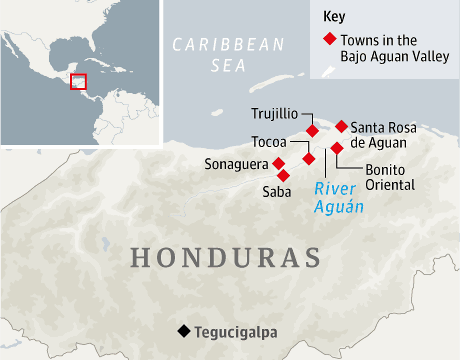
The Northern Triangle Countries:
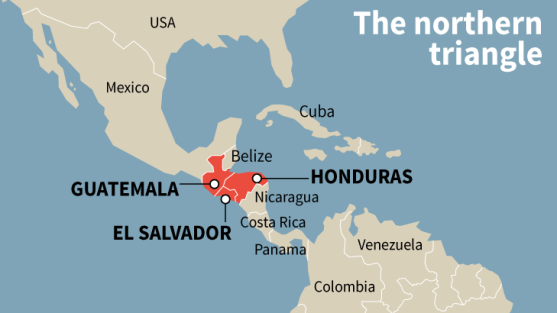
MIGRANT ROUTES FROM CENTRAL AMERICAN
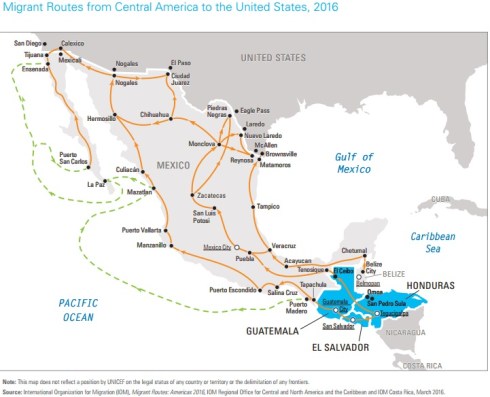
UNACCOMPANIED CHILD BY LOCATION OF ORIGIN: 2014, GUATEMALA, EL SALVADOR, HONDURAS
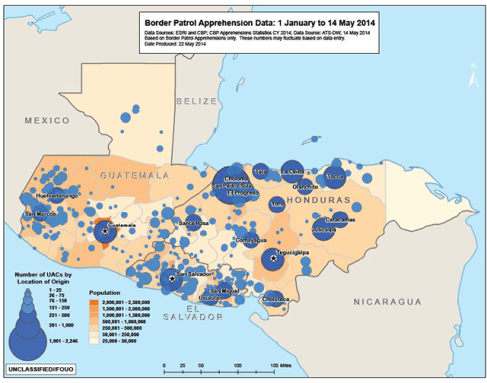
THE BAJO AGUAN VALLEY – HONDURAS

According to the April, 2017 article, “Central American Immigrants in the United States by Gabriel Lesser and Jeanne Batalova,” in 2015, eight percent of the 43.3 million US immigrants lived in the U.S., and the majority (85 percent) were from the three of the seven Central American countries. Immigrants from the three countries of El Salvador, Guatemala, and Honduras, known as the Northern Triangle, made up the largest growth in U.S. population since 1980 (90 percent).
The following chart displays the population of Central Americans in the United States according to country as of 2015. (credit: Migration Policy Institute, April 5, 2017)
| Region/Country | Number | Percent |
| Central American Total | 3,385,000 | 100.0 |
| El Salvador | 1,352,000 | 40.0 |
| Guatemala | 928,000 | 27.4 |
| Honduras | 599,000 | 17.7 |
| Nicaragua | 256,000 | 7.6 |
| Panama | 104,000 | 3.1 |
| Costa Rica | 90,000 | 2.7 |
| Belize | 49,000 | 1.4 |
| Other Central American | 7,000 | 0.2 |
According to the authors of the report (Lesser and Batalova), the Central Americans who have acquired “legal residency” also known as “green card,” have done so via family reunification channels, i.e., the process of the immigrant request and granted location of residence in the U.S. with a family member who resides in the U.S., that may or may not have the legal residence status.
Another way of migrating to the U.S. is through the Temporary Protected Status (see article by Madeline Messick and Claire Bergeron, July 2, 2014) or TPS, which nationals from El Salvador and Honduras have been beneficiaries. The TPS is granted by the U.S. government and allows individuals from designated countries to seek protection from deportation and to work, although it doesn’t include a “green card.” In fact, the specific provisions of this temporary status are that the beneficiaries are not eligible to receive permanent residency nor citizenship. Once, the TPS expires, if the U.S. does not renew it, the beneficiaries’ immigration status is back to the very beginning. At the time the article was written in 2015, there were 212,000 Salvadorans and 64,000 Hondurans that were in the U.S. with a TPS. The U.S. grants TPS designations to six countries besides El Salvador and Honduras: Haiti, Nicaragua, Syria, Somalia, Sudan, and South Sudan. A total of 340,310 reside in the U.S. with protection from the TPS (Guatemala is notably not on the list.)
Countries may be designated TPS based on one of three reasons: there is an ongoing, armed conflict that poses great danger if the migrant returns; as a result of a disaster such as an earthquake, flood, health epidemic, etc., a country may request a TPS designation until it is safe for its people to return; and, “extraordinary and temporary” conditions that prevent the people from returning safely.
According to Rosenblum and Soto (2015: see report, “An Analysis of Unauthorized Immigrants in the United States”) there are 436,000 Salvadorans residing in the United States. An additional 212,000 Salvadoran have been granted Temporary Protected Status. A great number of Salvadorans live in California and Texas, but also, in the East Coast: Maryland, Virginia, and Washington, D.C.
Approximately 704,000 Guatemalans live as “unauthorized” in 38 states and the District of Columbia. In California alone, there are 200,000 Guatemalans. However, Guatemalans are also dispersed throughout 12 states in the East Coast, and around 10,000 reside in the states of Tennessee, Illinois, and Alabama.
About 317,000 Hondurans live as unauthorized immigrants in “significant numbers” in 23 states, but they are concentrated in Texas and Florida. They also reside in California, the East Coast and Louisiana. The number excludes the 64,000 Hondurans that reside with a Temporary Protected Status.
As a result of the surge of Central American unaccompanied children in the 2014, the U.S. State Department allocated 86 million dollars for Mexican authorities to “stop” the flow of migrants to the U.S. border. Although, Mexican laws address special protection measures, the implementation of these policies are uneven and flawed (see article, “Strengthening Mexico’s Protection of Central American Unaccompanied Minors in Transit”). Amongst the essential gaps in the implementation were “poor screening and inadequate housing,” and in 2016, less than 1 percent of the 17,500 unaccompanied children which were stopped by Mexican authorities applied for asylum, but no assurances were given that their requests would be granted. Critics noted that in most cases, children were not asked if they wanted to seek asylum in Mexico. Another serious angst among critics was that so many unaccompanied youth detained and deported would be returned to a very dangerous situation in their country. The women’s stories strongly suggest that there are substantial situations to warrant these fears and concerns.
According to an interview with National Public Radio (NPR), writer Sonia Nazario explains that the “catch and deport before they reach the border” has not deterred the Central American migration, and in fact, made the journey more dangerous. The migrants were kept from riding on top of the train that winds its way toward the north (called “la bestia or the beast”), thus, their journey through the Mexican routes became more perilous, and “open season on migrants,” by locals such as cartel or gang members, and even enforcement authorities. One of the women’s stories in this collection includes such a kidnapping and extortion incident (see “Jenni’s Story”). Additionally, the shelters, once a restive place for the weary migrant, are becoming like refugee camps where migrants must deal with the Mexican barrier that they must navigate and overcome.
The collection, “In the Shadow of the Half Moon” includes, in each story, a breakdown on how the problem of police corruption played a major factor in the women’s tragic circumstances. The women were not able to seek protection from the police and other authorities, and to a lesser extent, justice for crimes committed against them. In the case of Honduras, not only are police and the military complicit in crimes described as human rights abuses, as well as murder, but in a twist of cruel injustice, and despite the track record of human rights abuses, the Honduran government receives aide from the United States in the form of $18 million plus a $60 million loan from the Inter-American development Bank, approved by United States (see article, “America’s Funding of Honduran Security Forces Puts Blood on Our Hands”). Critics of the aid consistently allude to the abuses of military police forces that have resulted in nine killings, 20 cases of torture, 30 illegal arrests between 2012 and 2014, and 24 soldiers are under investigation for the killings (see Human Rights Watch Report). Also, and very disconcerting, over a 100 activist whose farm lands were at risk of becoming exploited for corporate greed have been killed since 2009. The Honduran security forces are suspected of the murders but the lack of substantial results have unnerved Hondurans and lost their confidence in the justice system. Honduran President Hernández’ use of military might for domestic purposes is clearly in violation of the country’s constitution and many critics urge the United States to withhold funding until the human rights abuses have been resolved.
Why do thousands make the decision to migrate to the United States, legally or illegally, risking their lives and forging a new life strife with unknowns and incredibly stressful? Understanding the reasons requires more than just a cursory knowledge of each country’s history, especially on how events shaped the aspects of social, infrastructure, economic, and political situations. Many writers and journalists offer critiques on the current affairs of the three countries by pointing to the United States past role or intervention such as in the civil wars in El Salvador and Guatemala. Valeria Luiselli is one such writer, adding that gang violence in the Northern Triangle region is largely due to the deportation of gang members from cities in the United States to the region in the 1980’s. However, Luiselli is most critical of Obama’s administration immigration policies during the 2014 peak migration of Central American unaccompanied youth. The juvenile cases were ordered to be processed as quickly as possible within a three-week window (see her article, “Why did you come to the United States?” Central American Children Try to Convince Courts They Need Protection”). The “fast track” system didn’t allow the youth to develop defense against deportation, so the odds against them were stacked, especially without a legal counsel to represent them. To Luiselli, the government acted in the most cruel and irresponsible manner, leaving the asylum seekers with no other choice but to be deported to the dangerous places they tried to escape. As long as the United States government refuses to acknowledge their role in causing the roots of the problem, and by refusing to describe the children as “refugees,” the migrant children will not be treated fairly and justly.
Journalist Julia Preston writes about the legal problems of Central American parents and their children in the United States courts. She notes that out of the 100,000 cases that have addressed the immigration courts since 2014, only 32, 500 cases have been issued rulings, and a staggering 70 percent of those cases concluded with deportation orders “in absentia,” whereby the migrants did not show up for the hearing and yet received deportation orders. The immigration courts are problematic for many reasons, and needless to say, the migrant cases are clearly marked for deportation and an otherwise ruling would have to be based on the judges’ notions for the migrants seeking asylum. See article, “Fearful of Courts Asylum seekers are banished in absentia.”
El Salvador’s historical accounts of war and violence includes the uprising or revolt of the 1930’s that culminated with a battle that resulted in the massacre of 30,000 indigenous peasants on the side of land reforms, and to end the wide inequality wrought by centuries of the dominance of the oligarchy (the “fourteen families”). The uprising was led by members of the so-called communist party, which was generated by Farabundo Martí and others, although Martí’s name remains as a central symbol in the political party, the Farabundo Marti Liberation Front, or as it was named in 1980, the FMLN. After the slaughter of innocent people known as “La Matanza” in 1932, Marti was executed by the same dictator, President Hernández Martínez, that ordered the killings of the indigenous peasant/farmers. (See article, “El Salvador 12 Years of Civil War,” the Center for Justice and Accountability’s Transitional Justice Project.)
Although the massacre highlighted the ending of a chapter in El Salvador’s history of war, the conflict continued. Throughout the 60’s and 70’s, right-wing paramilitary death squads and left-wing guerillas fought each other continuously, and in 1979, in an attempted coup, the dictator Carlos Romero, was ousted by “moderate” leaning officers, and a new government, the Revolutionary Government Junta, or the JRG was formed. But, in the following year, the JRG leaders resigned after an intense battle with the right-wing faction that used violent tactics to win their cause, such as bombings, kidnappings, and murder. Behind the ousting of the JRG as well as the murder of Archbishop and human rights defender, Oscar Romero, was a Salvadoran Army officer Roberto D’Aubuisson. He was briefly jailed but was freed due to the violent pressure imposed by his right-wing comrades. D’Aubuisson was a major force in the formation of the right-wing political party, the Nationalist Republican Alliance Party or, ARENA, and remained a leader of the death squads throughout the Civil War of 1980-1992.
The FMLN emerged as a military/guerilla organization after four other similar groups were integrated. After the FMLN attacked the government with all its force, the United States began to support the right-wing government with military aid and advisors. The US intervention has long been criticized for its role in supporting a government that was not formed via democratic means. The US ambassador during this time, Robert White, was very critical of the “atrocities” committed during the counter-insurgency, and even referred to D’Aubuisson as a “pathological killer.” But, the Reagan administration was adamant about supporting the government, and even removed Ambassador White.
Salvadorans experienced the extreme horrors of war, and the infliction upon its people was unbearable. Besides the assassination of Archbishop Romero, beloved and respected by the largely Catholic community, there was also the despicable and horrendous crime of rape and murder of four American churchwomen by military and paramilitary forces in December of 1980. Then US president, Jimmy Carter, cut off aid to El Salvador, but was deftly restored with the election of President Reagan in 1980. To end the insurgency, the US provided the Salvadoran government with substantial military support, which led to the formation of the “Rapid Deployment Infantry Battalions,” a military arm trained by the US to carry out unspeakable war crimes. One such atrocity was led by the brigade, the Atlacatl, when, in the Fall of 1989 they descended upon the University of Central America and murdered six prominent Jesuit priest, their housekeeper and her daughter. The Atlacatl was the same brigade that had led the now infamous El Mozote Massacre in 1981. In December of 1981, an entire village, El Mozote, was annihilated within three days, using a scorched-earth tactic by the Atlacatl Battalion, armed and trained by the United States. Reports indicate that up to 1,000 civilians, men, women and children were murdered, while many were tortured before their executions. The known lone survivor, Rufina Amaya, was able to give testimony to the horror she experienced, including the killings of her family.
The 12-year Civil War that engaged the government and the guerilla and paramilitary forces resulted in the deaths of 75,000 Salvadorans due to massacres, executions, landmines, and indiscriminate bombing. The human rights violations were extreme where civilians were tortured, mutilated, disappeared forcefully, murdered, and women were raped. And although the left-wing political party affiliates blame the “amnesty law” that was shaped by both the right-wing Nationalist Republican Alliance (ARENA) and the Farabundo Marti National Liberation Front (FMLN), in reality no one paid for the injustices. Thus, Salvadorans live with a void in their lives, having experienced the horrors of war as victims or survivors and knowing that the people responsible would never be charged, much less punished. (See “The Salvadoran Town that Can’t Forget” by Sarah Esther Maslin.)
Perhaps, the most pressing problem in El Salvador is the organized gang, criminal activity that has permeated throughout Salvadoran society. The presence, indeed, the integration of gangs, notably MS-13 and Calle 18, have transformed the lives of so many, however, to many people that lived through the Civil War (1980-1992), the conflict between the two warring gangs and the military police and death squads is far worse than the Civil War (see “What We Have Now is a War,” by Maslin, Ramos, & Martinez, 2016) . According to the interviewees in the excellent documentary, “Gangs of El Salvador,” (published by Vice News on November, 2015; featuring correspondent Danny Gold) the Civil War is still on-going, but in comparison, the three-way conflict has far more complications.
El Salvador’s murder rate is destined to surpass Honduras that had been described as the murder capital of the world. El Salvador had almost 6,000 murders in 2015, as noted in the documentary synopsis, the highest number since the end of the Civil War in the 90’s. In a country of six million, the number of murders is too phenomenal to grasp in understanding its significance. The number of gang members vary according to the source, but some have stated as many 60,000 gang members live in El Salvador. Thousands live in prisons. The gangs actually originated in Los Angeles, in the 1980’s, which many point to the Civil War as the cause of the migration, spurring the exodus of thousands into the region. (Recall the United States’ role in supporting the right-wing factions in the Civil War during that time.) But, in the ensuing years, thousands of gang members were deported and became integrated into the Salvadoran gang life. The documentary features interviews with a variety of Salvadorans: mothers of young victims, families of gang members, ex-paramilitary and relative of victims of gang violence, a Calle 18 gang leader, gang members inside prisons, and others that would not speak on camera for fear of retaliation. Their testimony coincides with the women’s stories featured in the collection, “In the Shadow of the Half Moon,” and underscores the extent of the conflict throughout El Salvador: the fear of parents losing their children to the gangs, as recruits or victims; the extortions that take food from the table of one hard working, law abiding family to another family engaged in gang violence; the political climate that misses the mark in understanding how to deal with such a huge, multi-faceted problem, where politicians opt for the familiar “mano dura” or heavy-handedness approach, putting away gang members to languish in dangerous prisons or deploying death squads to kill them. The military force and the gangs accuse each other of being “terrorists.” Salvadorans see their country in ruins and worst, they believe that it can’t be re-constructed.
For more information on street gangs of El Salvador, go to “Migration From El Salvador to the United States Largely Due to Street Gang Violence and Related Factors,” in this blog.
Honduras, a country of 9.1 million people, has the unfortunate distinction of being a country of violence, where one of its city, San Pedro Sula, is the most violent city in the world (or closely behind Caracas, Venezuela), with a rate of 173 homicides per 100,000 residents. Reportedly, in 2013, an average of 20 people was murdered every day. (See article, “Inside San Pedro Sula – the Most Violent City in the World,” by Sibylla Brodzinsky and published by the Guardian in 2013.) Honduras is also the third poorest country in the western hemisphere: 62.8% or 6 out of 10 households live in extreme poverty.
The re-election on March 2017 of Juan Orlando Hernández, a rightwing Nationalist, pro-business, pro-security manifesto was replete with allegations of electoral fraud and voter intimidation. Critics of the president and his party cite the extreme human rights violations by the United States supported military and the private security forces hired by the corporations or wealthy owners that overpower the peasants and farmers who seek to protect their traditional lands from mining and oil corporations, exploiting the properties and displacing the residents, as well as corrupting the environment and tearing apart the economic and social well-being of the communities. The economic inequalities are deeply embedded in Honduran society since it is a straightforward oligarchy controlled by 10 wealthy families. The term given to describe Honduras, the “banana republic” (coined by author O. Henry) aptly describes the wealth distribution of the wealthy versus the working class.
At the turn of the century, Honduras’ banana companies (the United Fruit Company) became a huge cash crop for the owners and investors. However, the companies receded and bananas were gradually complemented with a diverse array of fruits such as pineapple, grapefruit, and coconut. In the 1980s the fertile Aguan region was the fruit basket of Honduras that provided jobs and edible products for its people. However, the recent development of the African palm plantations has replaced the edible products, up to 50%. African palm is harvested for the saturated oil which is used for processing foods, and as biofuel. The African palm industry has caused economic instability among the poor, working class, but has served as a lucrative investment for the wealthy.
As discussed in the abovementioned section, “The Case of the United States Funding Honduras,” the US influence and presence are evident in the military and funding support, plus there are several US military bases in the country. Honduras is a major point of transit for cocaine; as much as 300 tons pass through Honduras from South America. But, community leaders have become increasingly vocal in their complaints about the military forces joining with police and security forces to combat the MUCA (Movimiento Unificado Campesino de Aguan) resistance by using their military might to violate human rights, including injuring and murdering innocent people, stealing lands belonging to the people, and raping women. Private security guards paid by the companies outnumber the police force: five guards for every police officer. A type of “police state” serves to further suppress the working-class people that are clearly powerless, economically and politically.
City life in Honduras has problems of its own. In 2000, the mayor (Roberto Silva) declared San Pedro Sula as a thriving center of industry, and commercial and financial development. The clothing maquillas were notably successful, and the city contributed two-thirds of the country’s GDP (gross domestic product). However, beset with one of the worst hurricanes in the country in 1998 (hurricane Mitch), and a military coup in 2009, unemployment increased exponentially, affecting everyone from the middle class to the most vulnerable social and economic groups.
San Pedro Sula, besides stricken with economic and social woes, has one of the worst gang or criminal organizations, perhaps, in all of Central America. The two dominant gangs, the Mara Salvatrucha (MS13) and Barrio 18, control three sectors of San Pedro Sula (see article, “A Snapshot of Honduras’ Most Powerful Street Gangs” by Kyra Gurney). Over a thousand gang members from each gang work the streets of their territories, both making up 60 percent of the total gangs in Hondarus (see article, “Interactivo: Evolución de las maras en Honduras” for information on the areas controlled by either gang). The women in this blog’s collection consistently describe the gang’s internal conflicts, killing each other indiscriminately and causing havoc among the neighborhood, and many times innocent bystanders become victims of their battles. But beside the battles, which seem to erupt spontaneously and run a course of unpredictable duration, the gangs focus on maintaining their territories, either by seizing control or ensuring that they remain in their possession (see article, “Appraising Violence in Honduras: How Much is Gang-Related?” by M. Lohmuller & S. Dudley). Gang members use their “territories” to claim their physical space such as specific neighborhoods, and their “right” to invoke their power over the people via extortion, kidnappings, and even murder. But, gang members also reserve their power to seize control (and notoriety) for personal purposes. Reports from some sources point out the observable differences between the gang organizations: the MS13 shoot people whereas the Barrio 18 gang members use torturous tactics and then, mutilate the bodies and publically display them for the effect they seek (see article, “Life and Death in the Most Violent Country on Earth” by Flora Drury). The majority of the murders are unsolved, especially when the killings are deemed the work of gangs. There are instances when some sort of “superficial” actions for seeking truth and justice are practiced by the police, judges, and politicians, but for the most part very little to nothing is done to protect the people or punish the guilty for their crimes. It is no wonder that gang members feel empowered to run rampant their terror and deadly assaults on others with impunity.
Due to the economic, repressive, and violent gang activities and other related realities that Hondurans live each day, their inclinations to leave are understandable, but for many the choice to leave or stay is not an option since their lives or those of their loved ones, are in grave danger.
“Guatemala,” a “place of trees” was the name told to the Spanish conquistador Pedro de Alvarado used to describe the country by Nahuatl-speaking, Tlacaltecan soldiers, whom were among the entourage that Hernán Cortes had given permission to conquer in 1519. Indeed, Guatemala is known for its natural beauty with its abundance of such unique ecosystems whose biodiversity is renown all over the world. But Guatemala has experienced so many misfortunates, and today, it is a country with very low poverty levels: half the population of 15.8 million lives below the poverty line and according to the United Nations, 17 percent are categorized as extremely poor. Additionally, Guatemala, the most populated Central American country, has the lowest literacy rate with 25 percent of individuals over the age of 15 listed as illiterate. Even though the majority of Guatemalans are fluent or semi-fluent in Spanish, among them are 42 percent mestizo, and approximately 41 percent are described as an indigenous people; they are speakers of one of the 21 Mayan languages, including K’iché; Kaqchikel, Mam; Q’eqchi’: or two non-Mayan languages: Garifuna or Xenca. The indigenous people suffer disproportionately due to the rampant racism at institutional and social levels, and women and children seem to be the most vulnerable victims. The woman’s story in the abovementioned collection highlights the problems often shared by other women in similar situations.
Guatemala’s history is replete with political and civil unrest. A few highlights are discussed here.
In 1957, General Miguel Ydgoras Fuentes assumed power, under alleged rigged elections, after the then President Carlos Castillo Armas was assassinated. Ydogoras who authorized the training of 5,000 anti-Castro Cubans in Guatemala, provided airstrips in the region of Peten (later became the US-sponsored failed Bay of Pigs Invasion in 1961). But in 1963, Ydogoras was ousted in a coup led by Colonel Enrique Peralta Asudia. The junta of 1963 (which wanted Arévalo to return from exile) was forcefully stalled by a coup backed by the Kennedy administration and the New Regime dominated the terror against the guerrillas that had begun under Ydgoras.
In 1963, Julio César Méndez Montenegro was elected president of Guatemala and during his right-wing paramilitary, organizations were formed like the “White Hand” and the Anti-communist Secret Army, which were the forerunners of the “Death Squads” that caused havoc on civilians during the Civil War (1960-1996). Military advisors from the US Special Forces (Green Berets) were deployed to Guatemala to train troops in these organizations into an army, a modern counter-insurgency elite force, which became the most sophisticated killing machine in Central America.
In the 1970’s, two new guerilla organizations, the Guerilla Army of the Poor (EGP) and the Organization of the People in Arms (ORPA) began attacks against the military and some civilian supporters of the army. The paramilitary forces responded with a counter-insurgency attack that resulted in tens of thousands of civilian deaths. Due to the widespread and systematic abuses against civilians, the US ordered a ban on the support for aide toward the government forces. It should be noted that although then President Carter was behind the ban, American aide continued albeit through undisclosed means.
On January, 1980, a group of K’iche’ activists attempted to take over the Spanish Embassy to protest the massacres in the indigenous areas of the country but were overcome by Guatemalan forces that resulted in the deaths of every K’iche’ activist and the embassy was burned to the ground. However, a lone survivor of the assault and ensuring fire laid claim to the fact that the Guatemalan military killed the intruders and set the embassy on fire to erase the killings, thus, disputing the testimony of the Guatemalan soldiers who had claimed that the activist had set themselves and the embassy on fire.
General Efrain Ríos Montt became president of the military junta in 1982, whom President Reagan described as “a man of great personal integrity.” Ríos Montt continued the warfare known as “scorched earth,” responsible for the genocidal massacres of thousands of indigenous people, especially the Ixil, which were targeted for supporting the “resistance.” He was later found guilty of crimes against humanity. The court proceedings were broadcasted internationally in the Spring of 2013, and many indigenous women testified to the atrocities perpetrated toward men, women, children, and even infants. The women were perceived as courageous for their fortitude to stand up against Ríos Montt and others responsible for the torture and killing of their families and other innocent people.
But the 36-year Civil War had far more consequences than initially concluded. Although the government military forces carried out 93 percent of the human rights violations, which constituted war crimes, the US government via the CIA was complicit in these crimes because they trained the paramilitaries. (See “Guatemala Memory of Silence” by the Commission for Historical Clarification.) Over 450 Mayan villages were destroyed, a million people were displaced and approximately 200,000 people died. Most of the victims (83 percent) were Maya. Whether the war crimes constituted genocide was addressed in several reports and the conclusion was clearly stated that indeed, the military government’s actions constituted genocide. Although Ríos Montt was held largely responsible for the crimes against humanity, and was found guilty, the verdict was nullified due to legal proceedings. A retrial had been scheduled but was later suspended (see “Genocide Trial for Guatemala Ex-dictator Rios Montt Suspended”).
The US involvement in Guatemala’s history can be described as interventionist. President Truman’s interests in Guatemala were political, which at the time even the appearance of a communist government in the Americas was perceived as a threat. But, it was also perceived as an investment since the United Fruit Company had experienced lucrative success. But Guatemala’s incoming president, Jacobo Arbenz, brought forth agrarian reform, granting uncultivated land to peasants, and infuriating investment holders of the United Fruit Company. In 1952, President Truman ordered an overthrow of Arbenz but was unsuccessful. Soon afterward, President Eisenhower was elected and took up the plan to oust Arbenz by ordering the CIA to arm and train 480 Guatemalan soldiers, and in 1954 carried out a military invasion in Guatemala. Even though the military created a psychological warfare instead, its deployment was successful because it led to Arbenz’s resignation.
In 1963, the Kennedy administration supported a military coup that derailed the election of Juan José Arévalo, a politician who had the vision of Franklin Roosevelt’s social agenda and had been in exile since 1950. At that time, a strong campaign of terror to kill off the guerrillas was accelerated. The Civil War began in 1966, during the presidency of Julio Méndez who allowed the CIA to broadly and freely carry out their military agenda with the Guatemalan government.
The Civil War ended in 1996 when a Peace Accord was brokered by the United Nations between the guerillas and the government.
In her 2013 book, Adiós Niño: The Gangs of Guatemala City and the Politics of Death (see Review), Deborah Levenson makes the connection between the historical events in Guatemala and the social, political, and economic realities that have impacted gang members in the urban settings. The displaced Maya peasants, fleeing their countryside communities settled in loosely planned neighborhoods that seemed to grow exponentially overnight. But, it followed a pattern within a 20-year time span, and thousands of weary peasants started their new lives in unknown areas. The ex-military and paramilitary men became unemployed and added to an already huge unemployment problem. Or, they became security guards in legitimate and illegitimate businesses. Free trade capitalistic systems denigrated the working-class echelons, and those that chose to fight via unions were defeated. Thus, Levenson concludes that the structures of MS-13 and MS-18 were borne from this kind of environment. Even the gang members with their empowered status and weapons feel powerless. See Homicides in Guatemala.



Why do women from the Northern Triangle countries of Central America risk their lives along with their children’s, traversing through the treacherous, dangerous Mexican corridor, full of chaos and not knowing if they will live another day, if delinquents will steal their last peso, hurt them, or kill them? Why do they take the chance in full knowledge that they may not ever make it to the US/Mexico border?
These and many other related questions were troubling me when I spoke to several women detained at a Texas detention facility south of San Antonio. They were young, in their teens, or early or late twenties; many were single mothers, and all were from one of the three countries from the Northern Triangle in Central America – El Salvador, Honduras, Guatemala. My role as a volunteer was to help them organize and better articulate their reasons why they are seeking asylum so they can persuade the asylum officer in an interview to allow them to continue to the next step in the process, which would lead to their release from the detention facility.
As I listened to their intense, heart wrenching stories, explaining why they had decided to leave their home, their families, and their country, I realized that an underlying emotion racked their entire well- being: in their narratives were inherent pleas for “help,” for themselves and their children. In fact, many of the women seemed to be trauma victims although they had not been properly diagnosed and treated for lack of specialized care in the detention facility.
I worked with dozens of women during a six-month span. In the process, I started to analyze the emerging themes: some were victims of domestic violence, others of gang violence, but all of them feared for their lives and/or their children’s. All of the women stated emphatically that they could not return to their home countries for fear of persecution, which meant that if they returned they would eventually be killed.
For purposes of this writing project, I selected the narratives of seven women: three from El Salvador, three from Honduras, and one from Guatemala. Each story presented herein is a dramatization, an account based on the information they shared with me. Basically, these stories are factual, as they related the facts to me, in individual interviews that lasted approximately one hour. We were not allowed to tape record the interviews, therefore, I relied on my brief notes and memory to develop each story and, upholding each one as genuine and true, as much as possible, and in accordance to what they had shared with me. Naturally, the collection of stories is used as representative of the women’s experiences and provide only a small window to the multitude array of suffering and tragedy that have impacted each woman, indeed each family.
Very few people in our country understand the plight of the Central American migrants, specifically, why thousands have sought to cross the US/México border seeking to start a new life, sometimes as legal residents, but mostly, as undocumented workers. When the news that thousands of unaccompanied children from Central America were migrating to the U.S. became a crisis in the summer of 2014 (see article by Domínguez-Villegas), many people were surprised, and even disturbed by the numbers. Approximately 51,000 unaccompanied children were apprehended at the U.S./México border in fiscal year 2014. The numbers have since declined but then, increased, although not at the level seen in 2014 (see Rosenblum and Ball, Trends in Unaccompanied Child and Family Migration). However, the majority of Americans were not interested in their stories of migration, even though there were people who cared and gave the migrants some humanitarian care. But, the opportunity to learn about the migrants, especially the young families who risked their lives and gave up everything of their past, was lost and then, forgotten. The intent in publishing their stories is to inform, educate, and bring about the awareness and conscience of who we are as Americans living in a democracy where people are crying, pleading for our help, right outside our doorstep. Or, quite simply, my main purpose is to give “voice” to the voiceless.
The title, “In the Shadow of the Half Moon,” has a twofold reference. ‘Half Moon’ is a metaphor for the youthfulness of the women, and are seeking a new life to accomplish their lives’ goals, or to fulfill the rest of their lives in a safer space, perhaps, better, if not for them, then, for their children. The metaphor also describes the uncertainty of their future in the United States. Upon arriving at the border, the women’s emotional states are uplifted, and the reality of having to start all over again in a new world has not yet leveled to a reality. However, in the ensuing days, after their asylum process is motion, the uncertainty of what their future holds for themselves and their children becomes a source of anxiety. No matter how much they’ve struggled to reach the border, their encounters with conflict are far from over, in fact, they are replaced with new battles, problems, tribulations, and there’s a long, uphill process to become a citizen of the United States. Finally, the moon signifies “in the cover of darkness,” which brings to mind the fact that most of the women left their homes for the US in clandestine circumstances so no one would suspect their departure.
The following section includes the women’s stories, titled according to their names and home countries; of course, the names are fictitious to protect their identities. The stories contain the heart of what the women related to me thus, their brevity is focused on providing the reader with a friendly-readable format. Furthermore, at the outset of each story, I include an introductory summary that pulls the reader into the main narrative. Following this section, I include background information for the purpose of providing a contextual base to further explain the actions of the women.
Summary: Katarina was threatened by the leader of the MS in her vicinity, known as “el crazy,” and demanded that she must comply with his sexual advances or else he would kill her two children, ages 11 and 3. Katarina was living with her father and her two children while her husband, in the United States, worked to support the family. Then, her father died, and knowing that she was alone but receiving money from her husband, the MS leader began to threaten her. She moved in with her mother, reported her case to the police and then, on Dec. 25th left El Salvador for the United States. The police told her that she should leave for her own safety and her children’s, since they wouldn’t be able to help her immediately. If she returns, she feels that the MS leader will kill her.
The day that Katarina’s father died, her world turned upside down. “El crazy,” the ranking leader of the area’s MS (Mara Salvatrucha) had had an eye for her for some time now, and he knew that she had a son, age 11, and a daughter, 3 years-old. He also knew that her husband was in the United States and sent her money for living expenses every month.
Katarina wept incessantly at her father’s funeral. Her life had become increasingly difficult ever since her husband left for the U.S. Neither wanted the separation but making a decent living in her hometown is extremely difficult if not, impossible. Her father had been the anchor in her and her children’s lives. But now, his departing left her defenseless, and “el crazy” wasted no time to make his move and claim Katarina, the beautiful young woman, as his own mistress.
The grief she poured over her father was also rooted in self-pity and fear. Soon afterward, her worst fears became a reality. “El crazy” begin to call her, at first politely but then, aggressively. Katarina managed to keep him away by repeating her pleas to respect her marriage to the father of her children. But nothing deterred “el crazy” since he wanted to possess Katarina as a symbol of his prowess as a powerful cartel leader. He begins to threaten her, warning her that he would kill her children if she didn’t comply with his wishes. But Katarina would rather he kill her than her children, but by killing her doesn’t mean that he wouldn’t also kill her children.
Threats from a gang, any gang, usually target the children of their victims, hurting them where they are most vulnerable.
Despite the constant phone calls and harassment, Katarina managed to keep him at bay, but she knew that it was a matter of time before he would force himself into her life. After about a year, Katarina made her move. Christmas day was a natural distraction, so around that time, she moved out of her house, quietly, without anyone noticing. She moved into her mother’s house, reported her case to the police, and then, on December 25th she left El Salvador for the U.S. The police could not protect her from the powerful MS cartel leader who yielded perhaps more power than the police force. She was advised to leave the country, the police admittedly said to her that there was nothing they could do to help her immediately.
Katarina collected a few thousand dollars from her mother, her uncles, and her aunt. But she couldn’t take both of her children, so she chose her 3 year-old Adelia, and asked her sister, Rosa, to take care of 11 year-old Daniel Ricardo. Her sister had recently moved to another house so no one knew where she lived but she feared that the gang members would eventually find her sister and her son.
One way a gang leader shows off his rank is by collecting girlfriends or mistresses. “El crazy” singled out Katarina because of her attractiveness, and although she ignored him she feared him. While she acted politely to his advances, she didn’t give in. The gang leader would have destroyed Katarina instantaneously if she had outright rejected his advances. Everyone knows the rule: if you reject the advances of an MS leader, you will be killed. Death is the penalty for all rejections: for refusing to join the gang, for refusing to pay “renta” or “cuota,” and for refusing to become the girlfriend or mistress of a gang leader.
Rosa is a single mother of a son, Carlos José, just a year younger than Katarina’s 11 year-old. She knows Katarina’s desperation and the gang’s threat had to be taken seriously. Her boyfriend has asked Rosa to move in with him and she decides to do so as long as he accepts Katarina’s son as well. The agreement is a relief for Katarina since she feels that he will be safe with both of them, at least for a while.
Families caught in the web of threats and fear are constantly on the move, risking their lives, and even taking a gamble for even a small mistake can cost them their lives, and the lives of their families.
Such was the case of a family of four that lived in the same neighborhood as Katarina and her father. The father owned a small corner store in their home, selling a variety of goods and groceries. They were targeted by the MS and demanded monthly payments (renta). The family struggled to make ends meet, and the father did an unimaginable, unacceptable gesture to the gang by refusing to pay such an exorbitant amount of money that he could not afford. It was a mistake that led to his death as well as his wife’s and two sons. They were massacred by a dozen members of the MS gang, their bullet ridden bodies were found inside their home. The cold-blooded killings were the crass warning to others who dared to refuse the gang’s demands.
Summary: Maribel was raped by three members of the Maras gang. She was threatened with death to her and her family if she told anyone about the rape. Maribel didn’t tell her mother, but her mother immediately sensed that something was wrong due to Maribel’s depression and suicidal tendencies. After her mother learned about the rape, she called the police but received no assurances. Police expected payment for the protection or they were also threatened by the Maras. Maribel felt that she couldn’t return to school or even leave her home because the Mara gang member, Clarisa, continued the death threats and began to physically hurt Maribel. Then, after Maribel was badly beaten, her mother made the decision to leave their country and migrate to the United States.
Maribel was excited to return to school after a month-long Christmas vacation. At fifteen, she was determined to finish her high school program and continue her studies; maybe, become a nurse. Among the new students at her school one of them seemed to be very friendly with Maribel. She was Clarisa, a year younger than Maribel and seemed quite eager to make many new friends regardless of their ages. But actually, Clarisa was more interested in recruiting her classmates into the Mara gang, which she had joined a few years ago and was now a ranking female member. Typical of her group’s expectations she had to prove her worth by out-maneuvering her male counterparts. But Maribel refused Clarisa’s invitation to join.
Clarisa managed to entice several of Maribel’s classmates into her circle. Soon they would be among the many adolescents roaming the streets of their tightly knit community causing even more despair amongst their families already disconcerted over the rise of violence in their midst. Their hopes and dreams for their children have been shattered as they watch their beloved sons and daughters become consumed by the illicit drug culture.
Clarisa would not accept Maribel’s rejection. She threatened Maribel with consequences: physical aggression, rape, and hurting her family members. Clarisa and her recruits used social media to pressure Maribel but her resistance was firm, which annoyed and frustrated Clarisa.
Even though Maribel tried to avoid Clarisa, it seemed that she was following her and appeared at every corner she turned.
It was pouring rain when Maribel walked home from school one day in April. She decided to take the paved road instead of her usual shortcut through residential alleys. Clarisa and three male members of the Mara spotted Maribel as they drove through the street. It wasn’t incidental since they had planned to find and sequester Maribel, and punish her for refusing to submit to their control. They forced her into their car and took her to an abandoned shed a few miles from the main road. Maribel, screaming and crying, couldn’t pry loose from their stronghold. They hit her in the face and stomach and ripped off her clothes. Each of the men took turns sexually abusing her, while Clarisa added her venomous verbal assaults, also kicking her while she lay helplessly.
Maribel feared for her life, but in moments of sheer desperation and excruciating pain, she wanted to die. The four finally let her go but before they left, Clarisa threatened her: “if you tell anyone about this, we will kill you and your family.”
But Maribel’s mother immediately sensed that something very bad had happened. Maribel locked herself in her room, refusing to go school and hardly ate and drank anything. Her depression was profound and serious and her mother became desperate to find out what had happened. After days of agonizing anguish and despair, Maribel, crying uncontrollably, told her mother, “they raped me and beat me.”
Maribel’s mother felt the immense pain in her daughter, and to her utter disbelief she noticed that Maribel had attempted to take her life by cutting into her wrists with blunt objects. How could she help her daughter and bring to justice what Clarisa and the other three had done to her? Her first step was to report the case to the school officials.
The school administrators would not take any action since the rape had occurred off school grounds. Next, she turned to the police, but they also refused her case citing a lack of proof or evidence. However, they would investigate her case provided they were compensated for their work. They were reluctant to step into a situation which clearly involved Mara gang members. The dominant and powerful force of the Mara gang had crippled the police’s abilities to even protect the town’s citizens.
Maribel slowly emerged from her depression. A few weeks following the rape she was still weak and vulnerable and not attending school to avoid any contact with Clarisa. But she felt strong enough to leave her house for a short walk to the store to purchase some essentials. She was one block from her house when the Mara gang members approached her from behind and cornered her. They had been constantly monitoring Maribel and were determined to hurt her again as they had warned her, in retaliation for denouncing, or attempting to denounce their crime against her. There were four gang members, wearing scarfs to disguise themselves, but Maribel recognized one of them as Clarisa. They knocked her to the ground, hitting her head and then kicking her stomach and back. Two bystanders yelled at them but fearing for their safety, refrained from becoming involved. Others joined in, shouting “to stop” beating the young girl that was noticeably hurt very seriously. They left, and Maribel, at the point of unconsciousness, laid along the side of the street writhing with pain and crying incessantly.
Her mother was at her workplace when she received the call from Maribel. When she saw Maribel, beaten, distressed, crying and screaming like she’d never heard before, she knew what she had to do. After a couple of weeks of collecting enough money for their journey, Maribel and her mother left their home quietly, when no one was watching them. They traveled across Mexico and then, turned themselves in to the authorities at the Texas/Mexico border.
Summary: Stefani, age 14 and in the seventh grade, and mother, Ramona, lived in southeast El Salvador. On January 26, 2017, Stefani was approached by two Mara Salvatrucha (MS-13) gang members wanting her to join their group. She refused. A few days later, Ramona opens the front door of her house and finds a dead man a few feet away. She and Stefani are traumatized; the dead man was from another colonia who had been reported missing but they never learned his name. Stefani realized that the dead man was a message from the gang that their death threat was real. Two months later, Ramona and her daughter were confronted by two other MS-13 members, repeating their death threat to Ramona, and pushed her to the ground. Ramona knew that the gang had “ordered” her assassination. If they remain in their country, they feel that they will be victims of death threats. There is no end in sight; the gangs (MS-13 and Barrio 18) are in constant conflict with each other and the police, and have near total control of many of the authoritarian structures.
At daybreak on January 29, 2017, Ramona, a single mother of 14-year old Stefani, wakes up to the sound of a vehicle pulled up in front of her house. She heard a ruckus as if several people were yelling at each other. She ran to the front door, opened it and discovered a body, on the ground just a few yards away. As she walked toward the corpse, she realized it was a young man that had been thrown out of a car. She saw his legs and arms mangled and his torso riddled with bullet holes; an image that jolted her heart and spirit. She knew instantly that this killing was the gruesome work of the criminal organization that plagued her town. Stefani caught up with her mother and both cried in desperation. The neighbors approached the scene of the broken, bloody corpse. They didn’t know his name, but they knew that he was from another colonia and had been reported missing, and presumed dead.
Stefani had another thought. It was a message from the Mara Salvatrucha (MS-13), deliberately sent to her. A warning, she thought, that if she didn’t comply with their demands she would be the next victim. Or, maybe they would kill her mother instead.
Days earlier, on her way to school, Stefani had been approached by two MS members. They wanted her to join the gang, but Stefani brushed them off, telling them that she couldn’t do anything like that. MS gang recruiters are trained to target their victims and persist until they complied. They would not accept Stefani’s refusal; to do so would draw a harsh sentence from their boss, and death was always an option.
Stefani, pretty, slightly built and looking younger than fourteen, was the “innocent” one, the perfect type to coerce and become the “soldier” at the mercy of a powerful influence that would take her away from her family. The more she refuses, the more they would clamp down and insist that she meet their demands. Stefani knows that she must follow the rules: “ver, oír, y callar” (see, hear and be quiet). She knows the consequences for refusing to join them, and she could be killed like the young man they found in front of their house.
But Ramona suspected that something was wrong with Stefani. Stefani’s reaction to the corpse seemed overwhelmingly emotional, and she wouldn’t respond to her questions about what was going on. Ramona noticed that a particular car would constantly drive by in front of their house. She suspected that Stefani would be harmed so she decided to accompany her to school and back, everyday, keeping a close eye on her daughter.
Two months later, Ramona and her daughter walked back home from school when they were confronted by one of the gang members. He wanted to know what Ramona was doing, trying to protect her daughter. But Ramona acted with defiance and told him that it was her responsibility as a mother to protect her. The man became agitated and responded by pushing Ramona to the ground. She landed hard and her hip hit a large rock. She managed to get up, struggling with the pain, and again, stood steadfast in front of her daughter. The man told her that she could not keep her daughter from “them” and to continue resisting will lead to her end. Ramona knew that it was a “death threat” and she had only one other option.
That evening, Ramona and Stefani packed a bag of essential items and made their plan to “escape.” In the early morning hours on the first day of April, Ramona and Stefani went downtown, hailed a cab and began their journey north.
Summary: Jenni received a threatening message from a known powerful criminal organization or gang, which her ex-partner had had a leadership role. At the time they were together, her ex-partner deceived her, keeping secret the fact that, not only was he a gang leader but that he had “betrayed” his boss and had to go into hiding. She found out the facts when he turned himself into the authorities at a US/Mexico border checkpoint. Her ex-partner, the father of her young daughter, is now serving time in a US prison. He eventually reached out to her and apologized. She told a friend that she had communicated with him and soon afterward, she received the letter from the ex-partner’s gang boss, that in retribution for snitching, the gang would kill her children, which Jenni felt could also mean her death as well. She went to the police but their recommendation was that she leave immediately. The gang is very powerful in Honduras and beyond, and she had no doubt that they would find her.
Jenni and her 3 year-old daughter, Yojana, came home one day after a day at the town’s carnival, just a few blocks from their house. As Jenni opened the front door, she noticed a folded piece of paper that had been slipped underneath the door. It was a letter, and she immediately noticed the signature markings of the powerful gang, the same one which her ex-partner had been a ranking member.
The message reeked of hatred and death threats. The letter was addressed to Jenni but contained the names of her two children as well as her parents and their addresses. The message was clear: “If she (Jenni) talked to authorities on her ex-partner’s behalf, her children and parents would be killed.” She knew that hurting or killing her family was the worst possible sentence that the malicious gang boss could order, and Jenni felt that she would be killed as well.
Jenni met Ricardo, her ex-partner and father of Yojana, five years ago after graduating from high school and planning to attend the university. Ricardo was smart and had money, although Jenni didn’t know the source of his income until after the birth of their daughter. He suddenly disappeared and Jenni didn’t hear from him for over a month. When he finally called her, he told Jenni that he was a gang leader and had lost the trust of his group when he failed to deliver a loaded truck full of drugs, mostly cocaine. The truck was stolen during a pit stop at a gas station. While they waited, his accomplices were shot dead and thrown out of the truck. The gang members suspected Ricardo of colluding with the suspects, probably members of a rival gang. Jenni was shocked and feared for his life, as well as hers. He told her that she would not hear from him again.
Ricardo drove his car from Honduras to the U.S. with the plan of turning himself in to the Border Patrol at one of the Mexico/US border checkpoints. He avoided detection from delinquents looking to rob migrants until he crossed into the Mexican state of Veracruz. He sensed that he was being followed which prompted him to abandon his car and complete his journey by hitchhiking. He entered the U.S. through a border checkpoint, and within a week he was in court, pleading guilty to charges of narco-trafficking. His lawyers requested leniency for Ricardo in exchange for information that prosecutors could use against other prisoners, many of whom were gang members from Honduras, the same country as Ricardo. For now, Ricardo was safe but not completely out of harm’s way.
Six months later, Ricardo sent a letter to Jenni explaining what had happened and asking her for forgiveness. He had deceived her but he promised that he would take care of her and his daughter upon his release.
Jenni was relieved to know that Ricardo was safe but knew that he couldn’t return to Honduras while he was on the gang’s hit list.
When Jenni received the threatening letter, she realized that the gang members had learned that she had been in communication with Ricardo. But she didn’t know how they knew. The only explanation was that her friend, Miriam, whom she had confided in, had told another gang member. She didn’t think that Miriam would tell anyone since her own brother had been a victim, killed by the same gang members for reasons which are not clear.
But now, Jenni had to leave and time was of essence. She contacted her sister, Stefany, several miles away and asked her to take care of her 11-year old, Rolando José. He would stay with Stefany while she traveled to the U.S. with her daughter. He would be safe, she thought, since he was not Ricardo’s son. Her sister had just moved in with her boyfriend at another location where not even her parents knew the address. Stefany and Jenni lived in constant fear since the rape of their older sister, Katrina, by gang members a year ago. Katrina was now living in the U.S. as an asylum seeker, and Jenni, upon entering the U.S. would also ask for asylum, and to live with Katrina.
Jenni contacted the local police even though she knew that they wouldn’t be able to protect her against the gang proven to be more dominant and powerful. But her sister’s case had taught her to denounce the threat, even if for just documentation purposes. The police advised her to leave the country for her and her children’s safety.
Jenni’s mother helped her collect a few thousand dollars, and early one morning, she and her daughter took a cab to the central bus station with only a shopping bag full of essentials. She hoped that their journey would be swift and, if not comfortable, at least tolerable.
But Jenni’s luck became unmercifully bad, and relentless during her daunting journey through México. The coyote or smuggler that took them through the notoriously dangerous zones drove an old car that eventually broke down along a deserted road. The smuggler called his boss, and when help was on the way, a car with a group of four men stopped behind them, drew their guns and demanded money.
Jenni, her daughter, the smuggler and three others: a teenage boy, and a young couple, were taken to an undisclosed house, in a rural area not too far from the US/México border. Jenni had no idea of its location, but she remembers a dirt road, the seamless semi-desert, cacti and brush fields, and no houses. They were taken to abandoned house with no running water and electricity and an outhouse several yards from the house.
As the morning emerged, Jenni saw through the front window a soft light and then, four men with guns, a stark and evil presence that sent a knot to her stomach. They wore dirty clothes, were unshaven and each had scraggly black hair. Jenni, her daughter and the others, frightened and stressed out, pretended to be asleep. The men demanded money and not just a few thousands of dollars. They were the Golf Cartel and Jenni felt that she and her daughter would not survive the ordeal. Her heart was weak; she was exhausted, but her daughter gave her the strength that helped her deal with the gang members, assuring them that they would do everything possible to settle the matter without they killing anyone.
The smuggler negotiated a money drop between his boss and the cartel members. In exchange, they would drive everyone back to the main road.
Everyone was relieved beyond comprehension when the cartel members dropped them off near their stalled car. Night was falling quickly and they started walking northward, ignoring their thirst and hunger pangs. After a short walk, a man in a pick-up offered to give them a ride to the nearest town. They felt that he was an angel from heaven, and after about an hour’s ride, they arrived at a small town. The smuggler managed to borrow a car from a friend and drive the group a hundred miles toward the Rio Grande border. They begin to walk along the shallow part of the river until the smuggler pointed them toward a canoe hidden in the bushes. They carried the canoe into the water, and carefully climbed aboard, first Jenni, her daughter, and the other woman, then, the man and the teenager. They paddled across the river, and were soon stepping on U.S. soil, feeling as though they had trampled across the entire planet. They started walking eastward on a country road. Jenni prayed that a Border Patrol agent would appear and take them to the checkpoint. When the patrol car parked in front of the group, suddenly, their relief made way to an acute thirst and hunger. Once inside the patrol vehicle, Jenni spotted a plastic bottle of water beside the driver’s seat. She gently asked the agent for a drink of water, but he quickly responded that he didn’t have any, and hid the water bottle under his seat.
Once they arrived at a Border Patrol checkpoint, standing outside as they waited for the agents to begin the documentation process, the teenage boy noticed a half-filled water bottle on the ground. He motioned to Jenni that he would share the remaining water with the group. He poured water into the tiny bottle cap, and one by one, each took turns casting water drops on their scorched lips and tongue, carefully and ceremoniously. It was a moment of joy for Jenni who was struck by the generosity and kindness of a teenager.
Summary: Deisi was a victim of domestic violence in her country of Honduras. She endured a torturous, brutal relationship with her partner (not the father of her child) for three months. He tortured her physically and psychologically; in different days he would beat her by kicking her, throwing her against the wall and to the ground, and choking her until she almost passed out. Other beatings, included cutting her face with a saw, and, drunk and on drugs, shooting at her, barely missing her legs. She began her trip to the United States on Jan. 2, 2017, and with her daughter and a friend, arrived at the border on Feb. 14.
Deisi felt as though her dreams had come true the day that Enrique asked her to marry him. She was 18 and he, 21 but had a relatively good paying job at a coffee plant. They rented a house, simple and cheap, and Deisi became pregnant. They decided to get married after the birth of their child.
Three years into the marriage that became too “demanding and difficult,” Enrique walks away, leaving Deisi disillusioned and solely responsible for their daughter. Deisi moved in with her mother and three of her siblings, confused and worried. Enrique begins to visit Deisi presumably to be a father to their daughter, however, his real motive was to take their daughter into full custody, regardless of Deisi’s objections. Thus, Deisi refuses to allow Enrique to see their daughter, causing a strain in the relationship between Deisi and Enrique’s families. Soon afterward, Enrique’s mother refused to accept their daughter as her grandchild.
Deisi met Juan through a friend of a friend. He asked her to move in with him, which, considering her options, seemed like a good idea. She was unemployed and had no resources other than her family to support her daughter.
Juan was a quiet but troubled 28-year old. He was known around town as a violent drunk but a good worker. Juan and Enrique worked at the same coffee factory and although they get along together, Juan despised Enrique, blaming him for having “stolen” Deisi from him and the jealousy rage that he endured during the time he and Deisi were married. Deisi didn’t know about Juan’s jealousy until later when Juan began to hurt her. Perhaps, that’s why he turned against her, she thought.
During the three months that they lived together Deisi and Juan argued and fought every day. At first, they were about Juan’s indulgence: drinking and socializing every day with his small circle of friends. But the arguments escalated and became increasingly more intense. Juan prohibited Deisi from going out anywhere except the grocery store once a week. He took away her cell phone so she wouldn’t speak to her family and friends. And, he disallowed visits from anyone other than his friends.
Every day was a repeat of the day before until Juan’s aggression included attempts at seriously hurting Deisi; perhaps, his motives were to kill her.
Deisi couldn’t escape Juan’s beatings because he would strike at any moment without any provocation. He punched and kicked her repeatedly, throwing her to the ground or against the wall. One night, while she lay sleeping, he choked her until she almost passed out. There were several near-death instances caused by Juan’s violent (and drunken) tantrums and persistent rage: the hand-saw to her face, leaving a scar on her right side of her face; the shooting with a rifle that barely missed her legs as she ran out of the house, screaming for help. Many times, Juan’s friends were there to “save” Deisi from the harrowing torture that surely would have ended in tragedy. And, the following day, Juan had no recollection of what had happened. He refused to admit to his violent aggressions.
Deisi’s pleas for help were ignored by her family and friends. But her brother lent her the money to purchase a cell phone. Now she was able to seek help that would enable her to leave the abusive relationship. Through the social media, she was able to contact friends and one of them, Eragdi, agreed to help her “escape” from Juan. But if she stays in her home country of Honduras, Juan will find her, she thought. Her only option is to journey to the United States. Eragdi decided to leave with Deisi and her then 5-year old daughter. The two women and the daughter walked out of the house carrying small bags to show the nosy neighbors that they were going shopping. In fact, it was the start of their long, six-week journey to the United States.
Summary: Rosenda’s life in one of the most violent cities in Honduras had been chaotic and overwhelming. She was a victim of domestic violence, and after the divorce, her ex-husband, the father of her young daughter continuously harassed and stalked her. She was also mugged at gunpoint by thieves on motorcycles. She and her neighbors are gripped with fear ever since the town was overrun by a powerful gang and then, after a serious, prolonged gunfight, and then, another one. Many innocent bystanders were killed while caught in the crossfire as rival gangs claim ownership to the lucrative illicit business like extortion, kidnapping, and running drugs. The current gang leader, a powerful man with a ruthless reputation now has a huge mansion in the neighborhood, and well-armed bodyguards. But of all the violent experiences, none compared to the one she lived in confrontation with one of the gang leader’s bodyguards, the husband of her cousin, Sonia. He threatened her, that she would be kidnapped, violated, physically hurt, and her three-year old would also be targeted. Like everyone else, she couldn’t count on protection by police since they are “owned” by the gangs. She cannot plan on a safe, secure future for her three-year old because of the violence and threats. Her only option was to flee her country, which she did with her daughter, and only the clothes on their backs.
Rosenda’s walk to the corner store two blocks away is like treading through a minefield. Except that, instead of fearing the fatal step, she looks for signs and sounds of gun battle; dodging the bullets with the careful vigilance of a hawk. She feels exhausted, and it’s not quite ten in the morning. She believes her town is gradually becoming her prison. She feels as though her whole life has been a prison. At the store, she meets up with Sonia, her cousin whom she considers her sister. They chatter as if they hadn’t talked for a long time, but actually they call each other on their cell phone each day. They share many interests since they grew up together. They even married their boyfriends almost at the same time. Unfortunately, they also suffered similar domestic violence in the hands of their repressive husbands. They all seemed happy in the beginning of their marriages, but life in a small town in Honduras hardens the men and makes the women powerless and vulnerable. Without a secure employment or even employment opportunities, women’s lives teeter on instability, both economically and socially. “The woman stays at home to take care of her man,” the husband, Salvador, would remind Rosenda of her place in life.
Rosenda doesn’t remember when the beatings started. Perhaps, the rough sex led to the casual verbal insults, then, the face slaps and hair pulls. Rosenda’s beautiful long hair was perfect for Salvador’s torturous aggressions, amusing himself by pulling Rosenda by her hair. Life became a drudgery full of physical and emotional pain.
Salvador left town when he realized that “men with guns” were looking for him. He owed money to a wealthy, shady landlord and his debt, about five years old, had to be settled. But Salvador didn’t have the money. Rosenda felt relieved but troubled. How was she going to provide for herself and her 3 year-old daughter, Kimberli?
Sonia’s marriage began to deteriorate right after the birth of their first child. Her husband, Juan, had been unemployed for several months, and for sustenance they relied entirely on the charitable generosity of her family. Juan hated their dependence on her family, especially since his father-in-law looked down on his inadequacies in providing support for his family.
But Juan’s luck would change when Don Robles and his horde of bodyguards and servants moved into the big mansion on the hilltop, just above Rosenda’s community. Robles was the powerful cartel leader, the latest crime boss to take over the town after running off the previous criminal organization. Juan sought employment as a bodyguard and was quickly hired. Don Robles was a notorious kingpin known to Hondurans as a murderous, heartless narco-trafficker that gives orders to prey upon innocent people and kill his competitors so he can amass capital and boost his powers. Juan became one of Robles’ “soldiers” and Sonia’s fear was elevated now that he owned a gun.
Juan became the loyal follower, a brand of soldier sought after by vicious cartels. His increasing absence from home gave Sonia some relief from his constant bickering and verbal abuse.
While he was gone, Rosenda visited Sonia and together they consoled each other. Joyful, happier times returned to their lives. But sometimes Sonia could not accurately predict when Juan would return home, and inevitably, he would show up when Rosenda was in the house visiting with Sonia. Juan grew suspicious of their friendship, imagining that they were plotting against him.
But Rosenda would continue to visit Sonia. She would leave through the back door as soon as Juan pulled up in his company car. Branding his gun and a macho attitude, he was a true-blue cartel soldier.
The beatings and verbal assaults became far more intense and frequent between Sonia and Juan. Rosenda became deeply worried and decided to confront Juan. But she quickly learned that this was a mistake. Juan turned his aggression toward Rosenda, and on one occasion pointed the gun at her head and warned her never to return to their house.
From that point forward, Rosenda helped Sonia design a plan to move out of the house, to an undisclosed location, where Juan would not find them. But, their hopes were dampened when Juan realized their plan. One of the neighbors, a woman who despised Sonia, snitched on the two women when she overheard their plan to move out the next day.
The threats were serious and relentless. Juan would call Rosenda several times a day, delivering verbal assaults. He threatened to kidnap her and her daughter, hurt and rape them, and kill them. Then, he would drive by her house, park his car and wait. He would send his fellow soldiers to guard the house, preventing Rosenda from leaving.
Rosenda kept vigilant and as soon as she noticed that no one was watching, she packed a small bag, dressed her young daughter and moved in her mother’s house.
A few months later, Rosenda sits quietly with her daughter on her lap, awaiting orders from the U.S detention center officials on what she will do next. She made it to the U.S., but fear still overwhelms her deeply.
Summary: María, 24 yrs. old is from Guatemala and her first language is Mam although she speaks Spanish well. The father of their five year-old daughter, Vergilio, abandoned them a year after her birth. She suffered physical and psychological abuse in the hands of Vergilio. His mother refused to accept María’s daughter as her grandchild. Her father is an invalid; he had a stroke and is paralyzed on one side of his body. He needs constant care and her 17 year-old niece takes care of him. María’s hometown is unsafe, especially in raising her 5 year-old as a single parent. A year ago, two young women were killed for unknown reasons; three years ago, her friend, also a young woman, was killed and her body dismembered. Only her head and a hand were found. Women are vulnerable in this community where men believe they can murder them without any repercussions. The police authorities are known to be incompetent and lacking in resources. None of the murders was solved. The fear and lack of employment opportunities have compelled María to travel north to live in the U.S.
Two slight figures stepped down the stairs of the passenger bus in a crowded downtown bus station in a city in central part of México. María, 24 years-old and barely 4’7, her daughter, Fabiola, who is 5 years-old but appears to be one or two years younger, make their way to the central hub of the station. Hungry, tired, and confused, the mother and daughter have spent seven days and several bus stops into their trip toward the U.S. border. A long way from their Mam-speaking community in Guatemala, they’ve reached the midway point. But this bus stop seemed the most difficult because all of their money and food were spent. But, María, determined to reach the East Coast of the U.S. to live with her older sister and brother-in-law, begins to scour the crowded bus station for food on the floor, the trash bins, anywhere for anything that her hungry child can eat.
María was accustomed to regular hunger bouts in her hometown, a small rural community in Guatemala where her culture and language have deep roots amongst the Mam people. She lived in the rugged, mountainous region where her mother, father, and two older siblings sustained themselves with homegrown vegetables and animal products. Their complete reliance on the weather and soil conditions created a subsistence living, and many times during the year, the family had to stretch out their basic essentials of corn, beans, milk and eggs to a bare minimum.
María approached the local street vendors as the first of many strategies that she devised. She asked for handouts for her very hungry child. The gentle sweetness of her voice seemed staged at first but the smooth resonance and kind demeanor in her expression is the normal voice that she uses when she speaks in Spanish. In her native language, Mam, her voice becomes less exact and more variable in pitch and tone, in keeping with the cadence of her indigenous language.
Some of the vendors quickly brushed her aside, others slipped a small portion of a taco into the hands of her child, or a piece of fruit from the fruit cocktail cup. But María wouldn’t touch any of it until her child was satisfied. Then, it was her turn.
María grew up as a well-loved child whose mother cared for her deeply. Even though her mother died when she was nine, she spent all day by her side, learning the chores, responsibilities, how to make small miracles from bits of morsels of food to feed the whole family, and how to defend yourself from cruelty and deception, especially from discontented neighbors and strangers. These were the skills and the lifestyles passed on from one generation to another, from grandmothers to mothers to daughters.
María grew up wearing the traditional dress called “el corte,” consisting of a colorful, multi-reddish skirt made from two rectangular pieces sown together then folded over and around her waist, and a similarly colorful cloth belt tied to hold her skirt together. The blouse was simply embroidered, white and tucked inside the skirt. She wore el corte everywhere she went except when she was asked not to do so, like inside the house she was hired to clean. That was the case at Doña Marta’s house in Malacatán, near the México/Guatemala border. She had heard from her friend, Rosenda, whom she worked as their housekeeper, that Doña Marta needed another maid. María took her daughter wherever she worked, and Doña Marta allowed both of them to stay and live in the house for which Maria was very grateful. But Doña Marta told her not to wear el corte, and Maria had no choice but to remove it and become a common housekeeper like all the rest, without a name or appearance that once identified her as the person she really was.
But leaving her culture and language behind was only the beginning of a new life for María. The choice to stay or leave Guatemala for the U.S. was the hardest decision to make but once she made up her mind, it became easier. She felt that she couldn’t go back to her rural community, a five-hour bus ride from Matacatán because of lack of employment opportunities, and although she loved her father, he was completely reliant on her niece’s care. Besides, the violence, especially against women, was a major factor in the need to create a better future for her daughter. Doña Marta was a good employer but her demands were increasing as Maria’s skills improved. How could she send her daughter to school, she thought, and still work overtime for Doña Marta? She felt homeless, detached from her community and had so little to give to her daughter. Her sister and brother-in-law promised to help her settle in once she arrived.
It took María and her daughter 15 days to travel to the U.S./México border from the Guatemalan border. Awaiting asylum proceedings at a detention center in Texas, she has no regrets. Yet, when will she realize that a new life means leaving behind everything she has ever known, to be who she is. How will she come to terms with her new life while her past is mostly made up of memories and dreams?


A colony of green papayas populate
A grove of the large leaf long-necks
That beg for water even if piped through
My water hose;
But one is surely the gay warrior, as
Yellow as the moon swimming amongst
Dark and green clouds;
Ready to fill our mouths with exotic pleasure;
What spell has fallen on the papaya loam
And made the earth fruits bloom?
My grandmother’s watering on a dusty
Hot, summer afternoon would
Signal a sudden gust of wind
As mild and breezy but fiercely
Embolden to push away the heat;
That magical touch that abuelita
Knew exactly the time of day
To sprinkle water on baked earth
And blessed our spirits and made us
Feel home in a small corner of paradise
That would soon fade away like memories
In a somber dream.
Train weaving along border memories of
my loteria and checkerboard life;
frames of family portraits fashioned
into a colorful quilt of sweet voices,
slight profiles, and happy, happy eyes
shining through our thoughts of
trepidation erected by border walls
setting us apart, away from each other
toward a reality that looms like a
head injury; a train wreck, no matter
where this train takes us the halt is
always erupt and deadening.
When we get off the train, when our
feet finally tread on steady ground,
you don’t know which side of the tracks
your heart lies.
Pieces of earth puzzled into
mosaic revelations of
gaps and stops;
the human stride hampered
by a matching duo of
transnational bridge and border wall;
for every bridge
there’s a wall and still,
the migration continues like
the ebb and flow of relentless
time and space, and
the rebirth and death of
day and night. Never stopping:
like a lake that cradles
the spewing brew, or
a river that collects cascading water,
or fresh sprouts of trees
fusing with fossilized stumps.
Humans’ undeterred spirits
run their gamut like water flowing,
roots reaching, and rivers
morphing into oceans,
deep, vast, and free.
Featherless flying beings we are,
embracing the essence
of our birthright.
The río bravo takes you across to safety
away from the clutches of jaws and jails;
The río floats you across into the arms
of the one that has loved you always;
The río saves you from the monster
that you dreamt about when you were five;
The río pulls you under until
your remains are deeply buried within;
The río haunts you in the darkest of
moments and shatters your dreams;
The río drives you mad
until your spirit dies with you;
The río turns you into a liar
and thief, a shell of what you used to be;
The río baptizes you and leaves you
naked when you think you know its eternal secrets;
Only the thick, mysterious fog can work its
powerful magic, dragging, stirring
its ghostly spirits, and unveiling the corpses
washed up on its shores;
The clouds, laden with sadness and anger,
open, and let the rain burst into tears;
Any other river like this
one would invite the locals
for a fun-filled picnic.
Instead, the Río Bravo looks desolate
Against the trappings of steel
posts, wired fencing, and
concrete military mesh.
Pedestrians on the Mexican side of the
bridge pour out into an open plaza,
darting toward waiting city buses.
The folk women, utterly
exhausted as they console their
children and grab on to bundles
of bulging plastic shopping bags,
bearing names of department
stores from the American side of the bridge.
When the border wall is erected
we won’t be able to see these
retail gobblers but who cares.
As long as the money keeps flowing;
globalism easily seeps through
impenetrable walls;
A preponderant fact for
the countless that everyday dare to
cross into the land of promise and
the purgatory of uncertainty;
We hear stories that make your head spin
like the one of how pets
are treated with dignity unlike our brothers;
and the earnings, no matter how long
and hard the work, barely
enough to put food on their table.
At the Mexican side, a
welcome-home flag awaits
those who failed to cross, big enough for
the world to notice how it flies more
boldly, bigger, and proudly than
the American flag behind them.
I know home when I get there;
Like a chameleon I carve my footprints from the
Natural hue of mud and sand pit spoils of la frontera,
A border rich with countless of untold stories.
I see like the border; I taste like the border;
I feel like the border; the border is all
Around me – but, mostly the border is in their eyes, anchored
At the sight of a new world; so desperate
To leave that only the absence of memory lingers.
Water droplet on scorched tongue,
like a fragile twig almost dead,
Too precious, too little, so wrong,
only a surreal existence lingers,
Fingers reaching for the empty
Plastic jug that feels like brittle
bones aching feet useless appendages
that burden every slight stride
Now slow and heavy;
life pleading with merciless sunrays
determined to kill;
Caged in an inferno of hell,
Let death be the victor,
Let death be the heaven that
brings peace, peace, peace;
And stops the agony.
 Cameron Park is one of 196 colonias in the county of Cameron, in Brownsville, in the most southern tip of Texas. The county shares its border with México, which is one of the descriptors that qualifies it as a “colonia,” according to the State Department’s website.
On my first visit, Cameron Park seemed familiar, not because it reminded me of a specific place but because of its characteristics, mostly as an impoverished or distressed community. I recalled my first teaching assignment as a bilingual elementary teacher in 1971 in Edgewood ISD in San Antonio, a Texas school district known to be among the poorest in the country. I had many questions then that I have for the Cameron Park community: What’s it like to grow up in a colonia? What do the children see and how does it filter into their lives? What lessons do they learn and do they think about a future when they will leave the colonia?
Cameron Park’s general character is not unlike what I had experienced, where the children and their families’ faced numerous daily challenges, such as street flooding due to poor drainage facilities, unlighted, poorly maintained streets, and generally, a intense level of poverty as reflected in the poorly constructed and run-down homes. The Edgewood community was known as the “barrio.” As a teacher, poorly paid in a less than adequate working environment, I could have sought to become employed elsewhere, but I too felt compelled to give back to the community, especially because of its unique needs. After four years of teaching, I chose to pursue advanced degrees, and even so, I decided to develop my professional career as an educator, working with communities just like Cameron Park.
My academic inquiries and research on how best to educate children and their families whose educational needs are often ignored or misunderstood have served as the basis for just about everything I’ve done professionally. In one of the service learning projects, I brought together university students from various state and out-of-state institutions with community members in small rural Maya-speaking town outside of Merida in the Mexican state of Yucatán. In an informal yet communal sense, we formed a “center of learning,” using language and culture as an exchange mechanism. We learned from one another; our group, ranging from 17 to a dozen within the three-consecutive summer timeframes, taught English to the interested community members (upon their request); and, in turn, they taught us Maya, and aspects of cultural and social practices that we could participate, at least as participant/observers. The more we learned from one another, the more we became “integrated” as a community.
My background as well as my professional work is central to the theme of this narrative. Without the specific lens I wouldn’t be able to understand the deep layers of context and the outcome of my narrative would be very different.
The two-part narrative begins with my interview with the Tutorial Center director, then, I focus on my perception of the community, including descriptions or observations, and a photo gallery.
A Visit to the Center – The Heart and Soul of the Community
I made an arrangement to visit the neighborhood Tutorial Center one afternoon in the fall of 2014, and noticed that the building was one of several in the Catholic Church complex. My first conversation with Angela*, the Tutorial Center’s director, was at first quite formal, but we soon realized our common interests in working with community-based learning projects, and our formality quickly turned to the urgency of “knowing,” and building “la confianza.” I asked only a few questions, and Angela responded with an impressive comprehensive narrative, as if on cue, filling in the information, even with only a few basic prompts. The exchange of dialogue with familiar and unfamiliar responses, underscored the need for what researchers call the “overlapping data collection and analysis” (Huberman and Miles, 2002, p. 15), specific to the methodology used in qualitative research. The information shared by Angela was for the most part “known”, however, the filter by which I perceived the data was laden with auto-ethnographic knowledge and experiences. Angela related a brief personal history, from the time she begin elementary school, graduated from high school, married and became a wife and mother. Her roots are firmly planted in Cameron Park. Building “la confianza” is essentially an important part of the process in learning about the community. There is a method, style, and strategy for collecting and analyzing the data. But the basis for working together is a matter of triangulating pieces of “knowing”, and filtered interpretations make connections, along with the multi-dimensional aspects of “knowing” derived from the lives and work of key players, such as Angela.
In my work as a researcher and teacher, I often begin my investigation(s) not with questions of what I don’t know, rather I find the common point of entry into what I and the community members do know. Thus, our understandings overlap as we create the context, narrative, and inquiry of frames that enrich our quest for what we’re seeking. As I reflect upon my conversation with Angela at the Tutorial Center I focus on the following information and questions:
For example, what role does the Center play in helping children not only succeed in their school assignments but in achieving overall school success? How are the students and their parents’ attitudes toward school shaped by their participation? Are the schools doing their part in helping the children, or are they satisfied with providing them with information on services they can access outside of school, e.g., referring them to the Center?
How does Cameron Park maintain its efforts and abilities to work within a restrictive language environment, helping children and their families succeed in the English language world of school while instilling cohesiveness among families and the community, culturally and linguistically?
Use of Contextual Factors as Lens of Understanding
Angela’s description of her views for understanding the community from her role as both resident and Tutorial Center director enables us to create an expanded cultural landscape. Her involvement in the Catholic Church’s traditional practices is an example of how she combines the personal and the social with the needs of the community. Upon her invitation, I was able to participate first-hand in the annual celebration of the Virgin of Guadalupe held at the church, next to the Tutorial center. The event began with a group procession led by a decorative float with a few children sitting among bright colored Christmas lights. A group of about 50 community members walked behind a simply decorated float toward the church entrance, chanting hymnal phrases. The block-long procession included parents and their children, adults of all ages, and a couple of disabled adults in wheelchairs. Once inside the church, the narrator behind a podium welcomed everyone, and proceeded to the presentation of an enactment of the story behind the Virgin of Guadalupe, which is well known among the parishioners as a symbol of faith and adoration. The children acted with dignity and respect as required by the roles of Juan Diego, the youngster who saw the miraculous apparition of the Virgin of Guadalupe, the little girl about 10 years-old that played the Virgin, and the church dignitaries that at first doubted Juan Diego’s story. The story ends when Juan Diego displays the proof of the Virgin’s apparition, the cloth encrusted with the Virgin’s image and the bunch of red roses, heretofore unknown to produce in the dry, desert region where it took place. It’s a story that reminds the faithful that by believing their faith will deliver them from their problems, illnesses, indeed, even from their hopelessness.
Angela’s role was integral in helping children actively participate in the church’s event. As Director, she also guides the Tutorial Center in becoming an extension of the various community events that perform social and religious functions. By learning about the Center’s roles, by participating in the religious event, walking with the procession, taking photos and making observations, I became closer to understanding the “heart and soul” of the community, and wanting to learn more about their beliefs, perceptions, dreams, and visions for their community. Even so, I feel as though I have more questions today than when I arrived; each one challenging my understanding of the best ways to work with children and their families.


The Community’s Entrepreneurial Economic Activities
A six-square block survey of Cameron Park’s entrepreneurial activities produces a photo album of working residents in an array of businesses that bear the markings of a people that are self-sustaining, resourceful, and creative. Along the busy four-lane street that serves as one of the city’s thoroughfare and Cameron Park’s west boundary, several businesses stand out among others located inside the community. A sprawling restaurant with a large parking lot stands in one of the corners. Then, a row of small businesses closely follow each other: an optical eye wear store, a kick boxing fitness center, a beauty shop (a total of four shops), an adult day care center, a restaurant with cyclone fencing tightly fitted in the front area, a car garage and shop, a tire store, a laundry, a tortilla factory/taquería, a learning center/day care and thrift store, a panadería (bakery), an insurance company, a meat market, a boat repair shop, and a taquería with an air/water pump station. Even though the businesses seem to maintain economic vitality, these are uniquely different from those across the major street, which are of a higher capital status and economic level. On the “other side,” (outside of the Cameron Park boundary) these seem to have an upgraded capital as evident in their buildings and façade. Perhaps, there is also a sense of separateness by business owners on the “other side” as they compete with each other’s businesses. For example, the day care center on the “other side” boasts in large lettering that their business is “LICENCED.” There is no such labeling in Cameron Park’s day care center.
The residential streets of Cameron Park are named “calles” (streets in Spanish), with the “Ave”. listed in front of the name, such as “Ave. Carlos”, and “Avenida Eduardo.” Almost every house is encased within a four-foot or higher cyclone fence, perhaps, to keep out possible delinquents, but in full view of passersby are the owners’ materials, furniture, appliances, tools, etc. Indeed, every third or fourth house in some way or another displays their work or business, or the residents may prefer to leave or remain them outdoors. Fences are conveniently used to hang clothes in a garage sale fashion. Every block has a house or two with a variety of clothing and goods for sale, the kinds that one buys at a thrift store. A drive-inn style paletería (frozen treats) has a poster menu of items that the driver can select from and then, move through the store to purchase their selection. Now, residents don’t have to wait for the “paletería” truck with its “Hello!” song to make its way through their street to buy their favorite paleta. Other drive through businesses carry different kinds of items, such as beer, wine, snacks, and even mixed drinks, such as the “mix sencillo” and the “bomba.” Certain houses are most likely “repair shops” as evident in the number of small engine and appliances, such as lawn mowers, refrigerators, bicycles, etc.
The businesses seem tailor made for the community. The supply/demand dynamic is not consequential, but the manner by which they’re organized is not well structured or planned. There are businesses that may not have the full support of the community members. For example, there are three or four large fireworks stores in the area, perhaps, more than what the community actually needs. The drive-inn stores within the residential area may not bode well with members that perceive the alcohol consumption among the youth as extremely high and dangerous. A couple of local restaurants or taquerías may “play politics” by displaying the large campaign posters of certain politicians alongside their business names, obscuring the intentions of both the owners and the politicians. The noise levels may be highly elevated due to the businesses such as car repair garages and those with 18-wheelers and other large vehicles.
Cameron Park community members seem actively engaged in the work ethic that symbolizes the “American Dream.” If it seems within reach, the residents will strive toward its obtainment. Even if their entrepreneurial efforts pay off, there is evidence that many residents remain in the community for a very long time. Many homes are in the process of remodeling or repair, and new construction sites signaling the building of new homes are seen throughout the community. Not every entrepreneurial activity is a sound investment, however, the energy or spirit that propels the hard-working members is vibrant, and self-determination is evident to succeed past the obstacles and barriers that they encounter every day.
Challenges
Whereas the challenges of Cameron Park seem obvious just as they are in a similar community environment, the solutions are not easily forthcoming without knowledge of the history of the colonias.
In the 1950’s, the State established the colonias, so called because their counties were within a 50-150 mile proximity to México, for the sole purpose of creating a living space for people whose annual income was below the poverty line, lower than the State average of $16,700 (see the State Department’s website). The land earmarked for this initiative was deemed “agriculturally worthless,” and/or in a flood plain, in an unincorporated subdivision. The plots of land were divided and the only way to purchase a plot was with a contract of deed. This was a financial arrangement whereby the buyer could not resell the property until it was completely paid off. The buyer was left to his or her own resources to build the home, and in order to hook up the water the building must meet the standard inspection codes. Thus, families lived in subnormal conditions for extended periods because of financial retrains, which left them trapped in a situation that was extremely difficult to overcome. The community photo gallery that follows reveals the consequences of this plan that can only be described as an outrageous example of greed on the part of the developers, and the result of the irresponsible and negligible decisions made by county and State administrators and officials.
Through their own volition and hard work, the residents of the colonias have been able to procure the basic utility services as well as paved streets and streetlights, however, this is an on-going struggle for Cameron Park and many other colonias that still lack these services. The most alarming of the problems is the lack of wastewater infrastructure and potable water which without proper installments and oversights can result in the discharge of waste in flowing water that can end up in the Gulf of México, and the risk of tainted drinking water on the health of the families.
It appears that Cameron Park has developed into a community that understands the importance of working together, of building community relationships, and in working with the youth that they recognize are at once fragile and vulnerable, yet strong and motivated enough to create a better future for themselves, their families, and their community.
For Further Reading
Shirley, D. (2002). Valley interfaith: Organizing for power in South Texas. Austin: University of Texas Press.
Ward. P. (1999). Colonias and public policy in Texas and Mexico: Urbanization by stealth. Austin: University of Texas Press.
Shirley’s book chronicles the work of Valley Interfaith community organization in the Rio Grande Valley of South Texas who for fifteen years addressed issues related to improving housing conditions health care, unemployment, and school reform. Shirley’s research encompasses related local and regional problems that have heretofore lacked sufficient investigation, particularly in the parallel development of both community organization and school reform. Using the case study approach he chose three school communities to build quite thorough and comprehensive perspectives of Valley Interfaith’s collaboration with various community and school leaders. Each case includes an insider’s dealings with the various institutions – the local schools, State educational rules and policies, the political landscape both local or regional and state, as well as the cultural and economic characteristics of the selected communities. Shirley’s scholarship is broad and comprehensive and his study produced a wealth of information about the Valley Interfaith organization’s work and the communities and schools that they impacted on a short and long-term basis.
While Shirley’s insightful study provides the reader with a detailed and panoramic view of the various dynamic relationships between and among community members and school personnel, his research methodology is focused on the Valley Interfaith’s goals, strategies, and accomplishments.
Ward’s book, Colonias and public policy in Texas and Mexico: Urbanization by stealth, serves as a reference volume for information seekers of colonias on both sides of the US/Mexico border. The book is a product of an elaborate research project conducted by the LBJ School of Public Affairs at the University of Texas at Austin. Readers will acquire an in-depth perspective of a myriad of issues and factors associated with social, health, and economic well-being of the residents. Readers should know that his numbers have changed since the publication 17 years ago: there are now about 400,000 residents not 300,000, a total of 2,294 colonias, not 1,500 colonias; along the 1,248 miles not 868 miles on the northern side of the US/Mexico border in Texas.
*Angela is not her real name but used here as a pseudonym for privacy protection purposes.
References
Huberman, A.M., & Miles, M.B. (2002). The qualitative researcher’s companion. Thousand Oaks, CA: Sage Publications, Inc.
State Secretary of State Department, (http://www.sos.state.tx.us/border/colonias/what_colonia.shtml).
Acknowledgement
My heartfelt thanks go to Drs. Kathy Bussert-Webb and María Díaz from the University of Texas Rio Grande Valley and María Elena de la O.
ALSO:
Please see the article, Student Fights for Youth and Families in the Rio Grande Valley.
Here is an excerpt from the article written by Maria Rigou:
”One of the residents, Nidia Mireles, is the first in her family to attend college. Nidia is pursuing a mathematics teaching degree from the University of Texas at Brownsville, and is an active member of the Brownsville Border Youth of Proyecto Juan Diego.”
See more: http://www.equalvoiceforfamilies.org/a-student-fights-for-youth-and-families-in-the-rio-grande-valley/#sthash.UEvISG1d.dpuf
 This is a story about Carla’s journey from a struggling student in elementary school to a successful student in college.
My first interview with Carla Guadalupe Reyna was on April 7, 2015. At the time she was a 20 year-old Brownsville native who was soon to graduate from the University of Texas at Brownsville with a Bachelor’s degree in Kinesiology. Since then, Carla graduated and additionally, has completed the course requirements to become a Physical Education teacher and is currently preparing to take the State exam.
Early Schooling Experiences: Language as an Impediment and as a Resource
Prior to enrolling at Gallegos Elementary School in the Brownsville School District in the third grade, Carla spent three years at another Brownsville elementary school (Pre-K to first grade) where she learned in a total Spanish language environment, and at her second school, another elementary school in Brownsville, for a year and a half. It was in her second school that her education changed drastically since the instructional support in Spanish that she had depended on was completely absent. Instead, the academic language of instruction was completely in English. Without the Spanish language support, Carla struggled to keep up academically and at the same time she strived to learn English. When she enrolled in Gallegos Elementary School midway through the third grade, Carla was behind in her reading and language arts subjects due to her insufficient English language skills. The Spanish language had become merely an oral communication tool in the academic world since she concentrated on learning academic English.
Carla had to re-take the reading portion of the State mandated test in the third and fifth grades. Undoubtedly, the problem was that she didn’t know enough academic English to be successful in tests that were completely in English and at a more advanced level than she had learned thus far. Carla participated in tutorials during school and after school, reading books such as Charlotte’s Web, and completing computerized Accelerated Reading programs. She admits that the tests made her extremely nervous and felt stressful and pressured. Even so, Carla was an excellent student that was often praised by her teachers.
The third grade was especially stressful, recalls Carla. She was in an all-English pull-out program where she and eight others were given lessons on English reading specifically designed to help in passing the State test. Not knowing why she was selected made her anxious, and she had the worst fears about her abilities. She also thought that it was because she and her family spoke only in Spanish at home. She eventually passed all of the State tests.
Middle School and Beyond
While in the sixth grade in Middle School, Carla had an English teacher that was extraordinarily helpful. She consistently tutored Carla even in the seventh and eighth grades when she had other English teachers. The teacher was also the Chess Club coach so Carla continued playing chess, a game that she had learned while at Gallegos Elementary School. Joining the chess club at Gallegos was an after-thought since she had two choices: either sit in the cold gym floor every morning for almost an hour waiting for classes to begin or spend the hour in the library learning and practicing chess. Her decision paid off since she eventually won an award in her first chess tournament in the fifth grade. More interesting was the fact that Carla was able to teach her father how to play chess. They played regularly, and still do, sometimes spending hours on a Saturday morning, which her mother has difficulty understanding. Her father has become an excellent player, and very proud of the fact that he can occasionally beat his daughter, a chess champion.
Carla’s practicing and studying in her English and reading classes were also productive since as she recalls, she passed the reading portion of the State test in Middle School by applying the study techniques she had learned so well. She would read each question twice, then, summarize the story, paying close attention to the main ideas and the details. Then, she would answer the questions. She was very proud of the fact that she received a “commended” score on the reading State test when she was in the eighth grade.
Carla enrolled in Spanish courses as electives in the sixth grade and then again, in the ninth and tenth grades. Eventually, she used her Spanish language abilities to complete the Spanish Advanced Proficiency tests and receive college credit in a high school dual enrollment program (Early College High School). Ironically, what had interfered with her academic advancement in her early schooling became a resource that she later used to reach her goals of completing college-level course work in high school. Learning English was an enormous task and she understands the challenge of the need to continuously improve upon her skills, but she recalls that she could never have given up her Spanish, “how could she?”
Becoming Resourceful: Socialization as a Key Aspect of Academic Success
Carla’s parents were supportive of her education to a substantial extent, but their limited schooling experiences in México and lack of English skills posed barriers in their involvement at Carla’s school. Her parents were concerned over her seemingly slow process in learning English, especially when her older sister and cousins were increasingly communicating in English. Her mother was told by one of her teachers that they should watch more English language movies at home. At Gallegos, Carla felt uncomfortable participating in English language lessons including reading, which affected her academically. However, the Spanish language support that she received from her teachers and her classmates was invaluable in that she was able to acquire knowledge as sometimes needed, and most importantly, become resourceful, both academically and socially. Even though all of her lessons were in English, Carla had access to Spanish throughout her years at Gallegos. Her memories of the attitudes toward her native language by school staff and classmates throughout her education in elementary school were positive. There were no incidences where she was told directly or indirectly that she should not speak Spanish to her classmates, and her teachers often translated the English to Spanish to aid in comprehension. Thus, working cooperatively on academic tasks with her classmates became an important social basis for learning, starting in the second grade when she would solicit help on translating words and phrases from her classmates who excelled in English. Carla engaged in peer support throughout her schooling, but it became even more essential when she was in the Early College High School, and she and her peer support group met regularly. She credits peer support as one of the main resources for her academic success.
Would Carla been as successful in completing high school and earning college credits if she had not attended the Early College High School?
The decision to attend the Early College High School was difficult. She had to make a decision in the eighth grade on whether she wanted to enroll at Rivera HS where many of her friends and her sister were expecting to attend or the Early College HS. She recalls the letter she wrote to the Early College HS explaining her decision to attend, and yet, she wasn’t completely sure whether it was the right decision. After deliberating, she asked her father to mail the letter and afterward, felt it was the best decision.
She has no regrets. She recalls the support she received from her teachers as well as her peers. They worked together, becoming socialized in the academic world of higher education, and by graduation she and her classmates had accumulated a huge chunk of credit semester hours that practically amounted to the first two years of college. Carla had a strong sense that she would eventually pursue a college education. The fact that the Early College HS was a great opportunity that she took advantage facilitated her goal, but she was determined to attend the university and would have done so with or without the Early College HS. However, she can’t speculate how differently it would have been without the support and resources she received at the Early College High School.
Conclusion
Carla was able to reach her academic goals and as a result, the numerous decisions she made can be perceived as the “right” ones. Her entire educational journey clearly shows her work and aspirations as that of an excellent student. Even though she struggled and experienced failure, she was able to persevere and dedicate her life to pursuing her educational goals.
But stories of success are always rounded off with those of students that were not so successful, who “gave up” or were “pushed away” by the insurmountable problems that seemed unresolvable. Clearly, from Carla’s journey we can surmise that the absence of support by teachers and others dooms a struggling student’s chances for succeeding in school. There are many lessons to take away from Carla’s journey. However, an important one is that no matter how difficult the process in learning academic English, one doesn’t have to give up the Spanish language to succeed; Carla’s well-developed bilingual skills attest to that.
Photos

Why My Undergraduate Students Represent the Hope for a Better Future
My responsibility as a professor at a university on the US/Mexico borderland, the Brownsville/Matamoros border, was to facilitate my undergraduate students in acquiring knowledge and understanding in the art and science of teaching young children to read and write, to think critically and creatively, and to lead them toward a perception of themselves as effective teachers and agents of change.
In the year and a half as a full-time professor I took on the charge of working with my students, presenting my best foot forward with 45 years of teaching experience, and most importantly, getting to know each one as individuals and aspiring bilingual teachers.
Any kind of development, especially educational and psychological, defies specific standards of measurement to assess progress, but as many teachers will agree upon there are different ways to determine how much and what specifically students learn.
To be specific, I followed a simple plan but a critically-focused process in my investigation: I selected a few collections of my student papers and used them to discuss questions about them – who they are, why they want to teach, and how they plan to develop their “teacher role.” Without any pre-determined measurement notions, I chose an unfiltered dialogue framework, using my own experiences and perceptions as guideposts and springboards to elaborate on my responses.
How did you learn how to read?
This question asked my students about their earliest memories about how they begin to decipher meaning from texts and to any extent the contextual basis for their learning to read. Since their responses were in an essay format, I chose the most common and salient factors, which I organized in order to create a discussion thread. For the most part there were no surprises in their narratives, although some of their experiences were specific or unique to living on the border unlike anywhere else in Texas.
Before Entering School: The Role of Parents and the Availability of Books
I collected a total of 25 essays and from these I selected 19, which in my opinion contained the most vivid insights into the question of how they learned to read. Only three did not respond to the extent to which parents played a vital role prior to their entering school and whether they had access to children’s literature. But, of the remaining 16 essays, six students’ narratives relayed positive experiences concerning the availability of books that they could enjoy and were read aloud to them by their parents, usually their mothers. However, ten students wrote about how there were no books or other reading material in their homes, and their parents did not read to them. Some explained how their parents were too busy working to take time to read to them, and that the economic situation was so dire they couldn’t afford the luxury of buying books. Whatever the reasons, the students seem to understand the impact of social, economic, and educational factors that surrounded them and in most cases didn’t fault their parents but rather focused on their abilities and experiences that helped them overcome their problems.
Early Schooling Experiences: In Spanish and English
All of the students have Spanish as their first language. I wanted to know in which language they learned to read in school and how they learned English.
Twelve of the 19 students said that they learned to read in Spanish, their native language. But only four explained that they had learned to read in Spanish upon entering school in the Brownsville schools, while one of the students stated that she had taught herself. Seven students related their learning to read in Spanish due to their schooling experiences on the Mexican side of the border. Two students had spent their entire elementary schooling experiences in Mexico. One of the students described how she and her mother lived in Matamoros and crossed the bridge to Brownsville every day for six years. Her mother would drop her off at her school while she went to work and then, picked her up after work, usually getting home passed 6 PM. The remainder five students had completed a year of kindergarten or in one case, attended school in Monterrey, Nuevo León for three years.
The four students that had learned to read in Spanish in the Brownsville schools described their instruction as traditional and very brief, an average of one year. Usually, the Spanish language instruction helped students learn the basics of letter and sound recognition but very little on building comprehension skills.
All students had a common experience once they enrolled in the U.S. schools: they were required to learn to speak and read and write in English as quickly as possible. So, even though a handful of students received a very basic Spanish language reading instruction, everyone had learned the basics of English language reading by the end of the second grade. Usually, the common instructional method by which they learned to read was the Phonics Approach. But, most of their accounts included descriptions of an emotional, difficult, even traumatic process. They felt overwhelmed with the pressure of learning to speak in English, and even read and write it at the same time.
How did they accomplish this seemingly impossible multiple task? Several students credited their teachers for their extraordinary assistance in helping them. But there were friends or neighbors who also helped the students. One described the Summer School program and its invaluable resource. Some of the students benefitted from the computerized reading programs with their built-in motivational and incentive strategies. Even though most of the students’ parents were unable to help them in English they were instrumental in motivating them to do well in school.
But in each narrative I recognized a sense of determination to succeed in spite of the barriers or problems. Their conscientious-driven efforts seem to transcend their plight and even give way to the realization that they could do something so much better than what they experienced to improve the educational conditions for other children. Indeed, they felt empowered in their upcoming, new professional role as bilingual educators.
Consider the following excerpts from their narratives that point to their earliest memories on learning to read, and the language, cultural, and social contexts for which they had to adapt and/or negotiate. (English translations in parenthesis.)
*A1: Yo recuerdo cuando era niña yo no leía nada porque ni había libros en mi casa. Cuando cumplí cinco años mis papás decidieron ir a otro estado llamado Oklahoma porque aquí en el valle mi papá no ganaba mucho dinero. (I remember as a child I didn’t read because there were no books in my house. When I turned 5 years-old my parents decided to go to another state called Oklahoma because here in the valley my father didn’t earn enough money.)
A2: Ya que por venir de una familia humilde de los barrios de Matamoros estaba rodeado entre tanta ignorancia y entre la famosa pandilla del barrio Kerroli, la cual tenía abundancia de pandilleros metiéndose mugrero y haciendo de las suyas en el callejón donde pasé los primeros 9 años de mi vida. (Since I come from a family with humble beginnings in the barrios of Matamoros, I was constantly surrounded between ignorance and the famous gang from the Kerroli barrio, which had frequent occurrences of violent gang activity, where I spent the first nine years of my life.)
B: Yo no hablaba inglés. Mucho menos lo leía. Mis padres son de México y ellos en ese entonces no hablaban el inglés. Mi primera lengua hablada fue el español.
Muy a menudo tengo la misma conversación con mi madre de qué solo Dios sabe cómo yo aprendí el inglés. (I didn’t speak English. Or, much less read it. My parents are from México and at that time didn’t speak a word of English. My first language was Spanish. A frequent conversation I have with my mother is about how only God knows how I learned English.)
C: Mis recuerdos son de que en mi casa no había libros para leer pero si me contaban muchas historias del pasado. (My memories are that we didn’t have any books to read at home but I was told many stories about the past.)
D: En mi casa mis padres solamente hablaban español así es que no comencé a hablar inglés hasta que comencé la escuela. (At home my parents spoke only in Spanish so I learned English when I started school.)
D: En ese entonces tenía una vecina que estaba estudiando para maestra en la universidad, y tenía hermanitas de mi edad y siempre nos daba clases y se ponía a leernos libros, actividades o simplemente nos ayudaba con cosas que no entendíamos. Eso fue una gran ayúdame para mi desempeño con el inglés y con la lectura. (At the time, I had a neighbor who was studying to become a teacher at the university and had young sisters about my age and would teach us lessons, reading books, activities or just helping us with the classwork. That helped me a great deal in my learning English and with reading.)
I1: Mi mente podría haber entendido las cosas de diferente manera pero claramente recuerdo mi maestra casi gritando detrás de mí forzándome a leer. Me gritaba y agarraba mi dedo apuntando a las oraciones que debía de leer. (I might have remembered things differently, but I can clearly remember my teacher yelling at me, forcing me to read. She would yell and grab my finger pointing at the sentences that I was to read.)
I2: Yo me acuerdo que lloraba de niña porque por mas esfuerzo que hacía no podía aprender pero la maestra nunca se dio por vencida. (I remember crying as a child because no matter how much I tried I couldn’t learn, but the teacher never gave up on me.)
K: Yo aprendí a leer en español primero porque español era mi primer lenguaje. En mi casa se hablaba español siempre. Yo aprendí el inglés en la escuela, pero no recuerdo cuando. Lo que si recuerdo es que mis clases eran en ingles desde primer grado. Solo recuerdo que estuve en español mi primer año de escuela (kínder), y empezando primer grado todo fue en inglés. (I first learned to read in Spanish because my first language is Spanish. At home we spoke in Spanish at all times. I learned English at school but I don’t remember exactly when. What I do remember is that all of my classes were in English starting from first grade. I remember I had Spanish language instruction in kindergarten but starting in first grade everything was in English.)
M.I: Yo fui nacida en México. Mi primer idioma fue el español. Mis padres no tuvieron la fortuna de poder tener suficiente estudio. Mis padres crecieron muy pobres y tuvieron que empezar a trabajar a una temprana edad para poder ayudar a sus padres para que hubiera aunque fuera frijoles y tortillas todos los días. (I was born in México. My first language was Spanish. My parents didn’t have the good fortune of a good education. My parents grew up in poverty and they had to work at a very young age to sustain their parents so that they could at least have enough food. at least beans and tortillas on the table everyday.)
M1: The entire 1st grade for me was difficult. I was having a hard time reading so my Mom sent me to summer school and that is where and when I learned.
M2: I hope to some day help children who are having trouble learning how to read in English. It is one of my goals in life to do that. My parents and teachers changed my life completely. I would love to help someone the same way.
N: Cuando yo aprendí a leer en inglés mi experiencia fue terrible. Yo no sabía hablar en inglés. Mi mama hablaba puro español y mis hermanos le hablaban en español también. En la clase mi maestra no quería que fuera su estudiante porque yo no entendía el idioma. (When I learned to read in English my experience was terrible. I didn’t know how to speak in English. My mother and my siblings spoke only Spanish. My classroom teacher didn’t want me as her student because I didn’t understand the language.)
Lessons Learned
The students seemed to have learned an insurmountable amount of lessons as children growing up in a milieu that made specific demands on them in various aspects, including the border context where two different countries are literally joined together geographically but socially, culturally, and linguistically are quite distant from one another. Most of the students traversed across the border various times for different reasons, but in each case their crossing was mental and psychological as much as physical.
I asked them about what they learned from their early schooling experiences and how they would apply these to teaching; the following are some of their responses:
A: Lo que si se y no cambiara es que la literatura me ha hecho crecer culturalmente y mentalmente. (What I would change would be to increase the use of literature in the classroom – that will help them develop culturally and mentally.)
C: Like I mentioned before when I was growing up books were not at my disposal at home, maybe because my parents were not aware of it benefits and back then times were very different. Nonetheless, I did learn to read in school and I am very thankful for those few teachers I had who didn’t give up on slow readers like myself, I learned to gradually read at my own speed and I now enjoy reading as a hobby. Overall, the way I learned to read was perfect for me, and now it’s my turn to pay it forward and continue helping students including my kids how to continue reading and keep striving for more.
C2: Estoy segura de que todos los niños de primaria necesitan buenos maestros para que les ayuden aprender bien el L1 y así después cuando aprendan el L2 lo aprendan bien. Tras las malas caras que yo pase cuando era pequeña, eso me motivo a querer llegar a hacer maestra bilingüe y así enseñar bien a los niños a aprender bien las cosas que necesitan saber en la etapa de primaria por ejemplo el leer, escribir , aprender los colores, planetas, los diferentes anímales, etc. (I’m sure that elementary school students need excellent teachers that will help them learn in their first language so that when they learn their second language – English – they will learn it very well. Even though I had bad experiences when I was a child, nevertheless I’m motivated to become a bilingual teacher and teach my students what they need to learn, for example, to read, write, learn their colors, the planets, animals, etc.)
I: Ella creía que yo podía y no se equivoco. Al igual que ella yo quiero que mis estudiantes aprendan todos por igual ya sea que eso requiera de mas esfuerzo de unos mas que otros por que todos son diferentes y aprenden diferente. (My teacher believed in me and she wasn’t mistaken. Like her I want all of my students to learn equally well even though it means that with some students it will require more effort because everyone is different and they each learn differently.)
MI: Espero que en recordar mi propia experiencia, me ayude para hacer una maestra comprensiva con ese tipo de estudiantes y para animarles que así como yo pude superar el idioma, ellos también lo podrán hacer si le echan ganas. (I hope my past experiences will help me become a comprehensive teacher of students whose experiences are similar to the ones I had so I can motivate them, and just like I was able to overcome my language difficulties, so can they become successful.)
M: Pero ahora pienso que es bueno que los niños aprendan español primero y después el inglés. Lo que ayudaría mucho a los niños es que los papas empiezen a leer con ellos desde chiquitos, para que se vayan imponiendo con los libros y leerlos. Leer es muy importante en nuestras vidas, todo en este mundo se hace con leyendo cosas. Hasta ahorita siendo estudiante de universdad incluye leer miles y miles de libros. (But, now I think that it’s better that children first learn in Spanish, then in English. What can really help children is if the parents read to their children from very early in their lives so they enjoy literature and begin to read. Reading is very important in our lives and everything we do in this world requires reading. Even now as a university student I have to read thousands and thousands of books.)
N: Aunque fue difícil y aterrorizante mi experiencia de cómo hablar y leer en inglés, lo pude lograr. Creo que pudiera ver otras formas de poder aprender, pero por eso quisiera ser maestra para poder enseñarles a los niños de una manera más eficaz. (Even though it was difficult and tortureous to learn to speak and read in English, I was able to do it. I think there are other ways to learn and that’s why I want to become a teacher – to help my students learn more effectively.)
How will they measure up to becoming the very best teacher that they aspire?
My immediate reaction after reading their narratives is that their early schooling experiences have left a profound effect on their self perception as teachers, specifically on a wide array of social, cultural, and language aspects of teaching and learning. Their approach to working with children is based on not only their experiences as border crossers, second language learners, and living in economically stressful life but as independent learners who have developed skills such as self-reliance, resourcefulness, and self-confidence. They have strengthened their resiliency and understand how children, in a survival mode, mature at an accelerated rate.
What are the most pressing problems that bilingual teacher’s face in today’s schools?
The final question was created as a platform by which the students could elaborate upon their own vision of the problems as they perceived them and become critical in the way that they would address these.
C: I feel that there is not enough high quality bilingual programs for students at this time in all our schools. Some schools don’t even offer the programs, and being so close to the border I feel it’s a need. How are these students expected to learn? For us the bilingual program is English/Spanish and further up it can be any other language with English. A huge factor that also plays a huge role is social economic standing of students, not all students have that strong support at home to continue motivation at home. Teaching is a job from public schooling but what about home, who picks up the pieces there. It has to be a continuous role, learning cannot be placed on a back burner. It takes commitment from both home and school.
D: The biggest problem I believe bilingual teachers have today is that children haven’t yet mastered their first language when they are already trying to learn their second language. By living in the border I have seen first hand how children have a little bit of difficulty truly mastering either Spanish or English and they tend to speak a little of both or mix them up. I believe in order to learn a second language you need to have a good foundation and have mastered your first language in order to move on and be able to speak, read, and write the second language.
I: I would work hard to make sure to make my classroom is truly bilingual. I would work hard to make every lesson in Spanish and English. I would also try to make sure to make my classroom fun and not put too much pressure on the students with the standardized testing.
Conclusion
Although the students were free to express themselves accordingly, and indeed, their responses are widely revealing, the fact remains that there are so many questions surrounding their perceptions, experiences, and so many about them personally. Their young voices seem fresh and determined, and what we know is that they have had extraordinary experiences and are fueled with visions and ideas for improving the education of children.
What we don’t know is how long they will continue to work as bilingual educators and how they will change as they work in the educational system that is continuously changing and not always in a positive manner, and how their view points will change, and will they follow a career path that will lead them to leadership roles?
What I know about the students is that they are truly the best hope we have for the future our children, indeed, much more beyond that. We can build a better future provided that our work with students as future teachers is relevant, genuine, sincere, and rooted in the very best quality educational curriculum.
As I ponder upon these and other questions, I reflect upon my own experiences and the changes I made during the course of my career. I was 19 years old when I begin my educator career. I worked as an aide at the same time participated in Teacher Corps, a specialized federal program whose goals were to produce teachers for a vast explosion of students whose first language was Spanish. I remember the awe-inspirational moment when I realized that I was going to become a bilingual teacher to teach children like myself when I started school – without knowing a word of English. It seems even more incredible that I have worked as a university professor for over thirty years preparing students to become bilingual educators. Indeed, I feel very fortunate to have a real connection to the students, not only because of my professional training and experience, but because of our personal experiences and our backgrounds as children whose parents brought them to the United States from México for a better life.
However, even though I was born in a border town (Ciudád Juárez) and grew up in border cities on the Mexican side (Nuevo Laredo and Reynosa), my early schooling experiences began in the south central part of Texas. My students have deep roots in the border area where they have lived most of their lives. These experiences have shaped them in ways that I still struggle to understand completely. And, perhaps, that is the nature of our border life: the border is a classroom of life and in an organic, chaotic and immensely interesting way, we are constantly learning.
* Students’ names are not disclosed for privacy purposes.
In the late 1990’s the escalating number of migrants crossing the US/Mexico border through California and Arizona marked a new level of concern, engaging the public in protesting the undignified manner of treatment toward the deaths of migrant border crossers and their loved ones. However, in due time the Department of Homeland Security stepped up their efforts and resources that forced the migrant crossers to create new routes toward more dangerous, inhospitable terrains. Thus, the influx of migrants through the South Texas’ semi-arid, prickly, dense brush land increased, and so did the number of deaths.
According to the South Texas Human Rights Center’s history noted in their website, the initial steps began in the summer of 2012 when Los Angeles del Desierto, a non-profit organization from Arizona, contacted the Houston United and the Prevention of Migrant Death Working Group and relayed the reports received from families that their loved ones had disappeared, particularly in the Brooks County area. However, the 2013 report, Searching for the Living, the Dead, and the New Disappeared on the Migrant Trail of Texas was pivotal in mobilizing activists to take action in deterring deaths among the migrant crossers in the South Texas areas.
In May 2013, a community forum was held in Houston, TX, specifically to address the tragic deaths of migrant crossers in Brooks County. Emanating from the discussions amongst various activists was a plan to install water stations in areas where the migrants have been sited. These water stations consisted of a large “steel barrels” filled with several gallons of water. Another important goal sanctioned by participants was the establishment of a South Texas Human Rights Center in Falfurrias, TX, in Brooks County. The Center would engage in the intake of calls from families or friends who had not heard from their loved ones. And, the most complex of all tasks became the most important: to locate and identify the dead migrants and notify their loved ones.
The selected posts listed below which I wrote and published in the Center’s website, include commentaries to aid the reader with background information.
The South Texas Human Rights Center is an humanitarian community-based center dedicated to the promotion, protection, defense and exercise of human rights and dignity in South Texas.
The MISSION of South Texas Human Rights Center (STHRC) is to end death and suffering among migrant border crossers along the United States/México border through community initiatives.
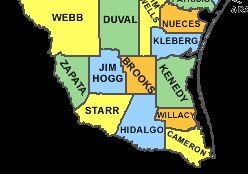 The 13 counties serviced by the STHRC include:
Brooks, Cameron, Duval, Hidalgo, Jim Hogg,
JimWells, Kenedy, Kleberg, Nueces, Starr,
Webb, Willacy, and Zapata.
The South Texas Human Rights Center is seeking donations to create and install “water stations” in areas where migrants are likely to trek and get lost. The water stations consist of a barrel with several gallons of water that will be placed and maintained in private properties in collaboration with the land owners.

Posted on September 6, 2013
 Living, the Dead, and the New Disappeared on the Migrant Trail in Texas, was written and published by Dr. Christine Kovic, a professor at the University of Houston-Clear Lake in collaboration with Houston United/Houston Unido. The summary findings lists a total of 271 deaths, which are recorded as migrant deaths for 2012, the highest number among the border states of California, Arizona, and Texas. According to the U.S. Customs and Border Patrol, most of the deaths, approximately 129, were concentrated in Brooks County, located in the center of the 13-county South Texas area, 70 miles north of the US/Mexico border. The Rio Grande Valley recorded the most deaths with 150, followed by the Laredo area with 90 deaths. This area consists of dry, harsh terrain known as South Texas plains and brush country with grasses, thorny brush, and cacti, and that has extremely hot and humid temperatures during the extended summer months.
“Migrant deaths have become the metrics of a failed border security policy.”
The major goal of the report is to call attention to the crisis and the dire need to take action to prevent more deaths among migrants crossing the US/Mexico border.
A key recommendation includes the installation of “water stations,” which the South Texas Human Rights Center is undertaking.
Acknowledgements listed in the report include a “special thanks” to María Jiménez, Tom Powers, Pat Hartwell, Gloria Rubac, and Stephanie Caballero, Alejandro Zuñiga, and Mesias Pedroza.
Also, the Texas Civil Rights Project, Eduardo Canales, Board President with the National Network of Immigrant and Refugee Rights, and Rafael Hernández, Director of los Angeles del Desierto/ Desert Angels.
Each pushpin in the map below indicates where the remains of migrants were located.
Posted on October 8, 2013
South Texas Human Rights Center is dedicated to saving the lives of migrants at risk of dying as they dangerously cross into the semi-arid, brush country of South Texas from México.
Other non-profit, humanitarian organizations involved in similar missions are No More Deaths/No Más Muertos and Los Angeles del Desierto, described in the following paragraphs.
Funded in 2004 by a group of community and faith leaders in southern Arizona, No More Deaths has the mission of ending death and suffering along the state’s US/México border. Their goals and objectives specifically describe their humanitarian mission to provide direct aid as needed, to witness and respond to social injustices, engage in consciousness raising, and encourage in as many ways possible a humane and just immigration policy. Staffed by volunteers, the organization established camps called the Arks of Covenant in areas where migrants were most in need of humanitarian assistance. But, in 2008, following the arrests of 3 volunteers who were transporting migrants to hospitals, the organization was adopted as a ministry by the Unitarian Universalist Church of Tucson, Arizona. The volunteers were eventually exonerated.
No More Deaths compiled and published a report that documented the abuses of migrants by Border Patrol Agents within a two-year period of 2006-2008. The report titled Crossing the Line: Human Rights Abuses of Migrants in Short-term Custody on the Arizona and Sonora Border, published in 2008, lists 345 complaints, described by the migrants, documented by staff members, and notarized, following a protocol supported by academic and legal processes. The complaints were numerous but were organized according to type and severity of the abuses. The worst ones were described as verbal, physical, and sexual abuses; failure to provide needed medical treatments; failure to provide and deny food substance; failure to respect basic dignity of the migrants; separation of family members, failure to return personal belongings to the migrants; and failure to inform migrants of their rights. The 112-page report describes the abuses in detail, which Border Patrol representatives rejected and/or denied these, claiming they were false or erroneous.
Three years later, No More Deaths published another report with new claims of abuses; this time 30,000 abuses are documented, however, many of the same kinds that had previously been reported. The 2011 report is titled, A Culture of Cruelty: Abuse and Impunity in Short-term U.S. Border Patrol Custody , and along with a numerous abuses, the authors also cited 1,063 incidents of migrant detainees not receiving due process. For example, their rights were violated; they were treated as criminals rather than charged for civil immigration violations; and were not given an opportunity to access a lawyer. This report underscores the need to advance the cause beyond identifying the issues to specifically articulating the steps to eliminate the abuses. Without taking action that resolves the problems, “the border will never be secure while human rights are being trod upon.”
Los Angeles del Desierto (Angels of the Desert), founded and directed by Rafael Larraenza Hernández and Monica Larraenza, is a “non-profit, humanitarian, search & rescue group made up of volunteers.” Although their headquarters is in San Diego, California, their search missions take them into the desert regions between the US and Mexican border. The organization coordinates their search and rescue efforts with the Border Patrol, The Department of Homeland Security, the Mexican consulate, Sheriff’s Department, and the Department of Forestry. They leave food and water that may provide essential relief to migrants, especially if they have become lost. Their goal is to save migrants whose lives are in danger. Their work also includes counseling and assisting repatriated migrants at the border entry gate in Tijuana, México to find their way back home.
Los Angeles del Desierto refrain from enforcing immigration laws since their mission is primarily humanitarian.
Posted on October 8, 2013
In light of recent reports on the escalating deaths of migrants in South Texas’ brush country, efforts have begun to address the myriad of issues regarding the tragic circumstances. Investigative reporter Mark Collette addressed some of the most pressing problems in the Corpus Christi Caller-Times in a special section on Immigration. Some of the newspaper article’s important information is described below.
The Need for a Central Record Keeping System
Very recently, Brooks County, which has the most reported migrant deaths, implemented a new policy of sending the body remains to the Webb County Medical Examiner in Laredo in charge of performing autopsies. However, other surrounding counties have different ways of handling and processing unidentified corpses. The Border Patrol has been an important source of information for compiling the number of confirmed deaths and approximate locations of where the remains were found. However, since the remains are found in private lands, Border Patrol officials are unlikely to divulge the exact locations. The following map shows the four ranches in Brooks County where the most deaths occurred within the last couple of years (2011-2013): Laborcitas, Mariposa, Cage, and King.
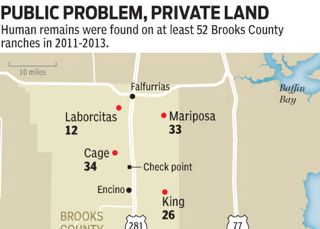
Interactive Map of Migrant Deaths
The Corpus Christi Caller-Times collected information on migrant deaths from 2011-2013 and used an interactive map to show the approximate locations of where the remains were found. The map displays all of the identifiable information, however, many of the remains are simply unknown. In an effort to identify the missing migrants a Baylor University forensic anthropology team has exhumed 55 remains from the cemetery in Brooks county where the corpses were buried. Their efforts will help identify some of the remains, especially the ones that have been reported “missing.”
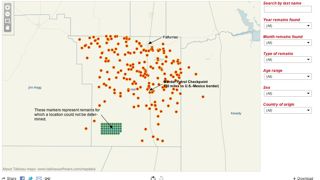
The Missing or Disappeared
The families or friends of the “missing” or “disappeared” are often unfamiliar with the process for reporting missing persons. The Corpus Christi Caller-times lists the following contacts where the identifiable information on the missing persons can be registered.
Brooks County Sheriff’s Office: 361-325-3696
Webb County Medical Examiner’s Office: 956-722-7054
Mexican Consulate in Laredo: 956-723-6369
Guatemalan Consulate in Houston: 713-953-9531
Honduran Consulate in Houston: 713-785-5625
Salvadoran Consulate in Houston: 713-270-6239
National Missing and Unidentified Persons System:
NamUS provides free DNA testing and other forensic services, such as anthropology and odontology assistance. NamUs’ Missing Persons Database and Unidentified Persons Database are now available in Spanish.
Posted on October 20, 2013
Falfurrias, TX – Brooks County is situated in the center of the 13-county area identified by the South Texas Human Rights Organization as the hotspot for migrant deaths. Falfurrias, the largest town in the county is a headquarters for the Border Patrol and the County’s Sheriff’s Office, plus a privately operated detention center. Thus far, in 2013, 80 migrant deaths have been reported in Brooks County, in an area comprised of private ranch lands about 956 square miles. Within a 12-month period, 3,100 juvenile migrants were “captured” and apprehended as they trekked through the South Texas dry, harsh brush terrain from the Mexico/Texas border. About 63 “walkers” or individuals carrying backpacks, turned over 12, 000 pounds of marihuana to Border Patrol officials. In a 2-day period, 1,000 pounds of marihuana were confiscated. Their activity log also includes hundreds of “rescue” missions, although their primary purpose is to capture and apprehend migrants for illegal entry into the United States.
But, the cooperation and the coordinated efforts between the Border Patrol and the Sheriff’s department have not been without immense challenges. According to Chief Deputy Urbino (Benny) Martínez, the overwhelming issues or problems in working with undocumented migrants is particularly strenuous due to the lack of resources in their department. Thus, the need to work out a close partnership plan with the Border Patrol, much of which is navigated through uncharted areas of procedures, legal matters, and protocol. This is not an easy feat by any means, according to Martínez.

Brooks County Sheriff Department
Sheriff Rey Rodriguez heads the department with Benny Martinez as Chief Deputy. About 40 staff members have various roles and responsibilities within the department, including the county jail. Their tight budget is a source of frustration since they must address local or domestic problems as well as those associated with the migrant influx. Although burdened with a proportionately large number of migrants, Brooks County is not a “border county,” thus, is not eligible for specific additional funding, like Cameron County, for instance, that reported seven deaths last year.

The Border Patrol has installed 4 Help Stations, one in each of the four major ranch properties. These include a five-gallon water jug and a “beacon” where the distressed migrant can call for help. However, the Sheriff’s department receives 90% of the emergency calls made from the migrant’s cell phones. Once the calls are registered, both the Border Patrol and the ranch owner are notified. Whereas the beacon signal is directly sent to the Border Patrol and readily identifiable, locating the source of an emergency phone call requires specific knowledge of the area. This task falls in the hands of Lionel Muñoz, a staff member with the Sheriff’s Department who uses the Google Earth app to pinpoint the coordinates and identify the most likely area where the distressed migrant may be found. Only two or three agents from each the border patrol and the sheriff’s county office are dispatched to the migrant’s location. Once the migrants are found, the Border Patrol assumes the responsibility in processing their deportation. Migrants who require medical treatment are transported to Kingsville’s medical facility about 35 miles north and then, brought back to the Border Patrol station in Falfurrias. Besides the one in Falfurrias, next to the Sheriff’s Office, other detention centers are available in nearby La Villa and Corpus Christi. (Read more about the “outdated immigration detention system” here.)
Migrant Deaths in Brooks County
Some reports of migrants that appear dead or ill are called in by Homeland Security agents aboard helicopters pursuing migrants on the run. But most of the migrant corpses are found by the ranch owners or their workers, usually precariously. Sometimes they’re drawn to particular sites such as the pathways often used by the migrants, or by a flock of scavenging birds circling above their target. Ranch owners are reluctant to allow just anyone in their property citing legal concerns in which they may be held liable for injuries or deaths. (Read about a related case, Rodriguez v. Boerjan.) Federal and county officials are obligated to inform ranch owners of their presence in their property before they’re allowed into the property. When migrant deaths are discovered both the Border Patrol and the Sheriff’s Department are summoned to the deceased person(s). However, the Sheriff has the major responsibility for processing the corpses or their remains.
Just recently, Brooks County established a policy whereby unclaimed remains of presumed migrants are sent to the Webb County Examiner’s Office in Laredo. Dr. Stern, the medical examiner, conducts identification tests, including DNA assessments that may assist the Sheriff’s Department in locating the decease’ family members or friends. The remains are transported back to Brooks County where they are temporarily stored in a designated area in the Howard Williams Funeral Home.
The Sheriff relies on particular invaluable institutional resources to facilitate in the corpses’ identification process. For instance, Baylor University, a private institution in Waco, Texas, has offered to conduct forensic analysis on skeletal remains. Professor Baker, a forensic anthropologist, engages her students in conducting on-site analysis, and provides an exceptional service to Brooks County without adding to their financial burden. Another important resource is Texas State University in San Marcos, which provides a “body farm” facility to process and store unclaimed corpses that have been exhumed from the cemetery in Falfurrias. Thus far, only half of the hundred or so corpses in the cemetery have been exhumed and processed for identification purposes.
Identifying the Corpses and Notifying the Next of Kin
Perhaps, the most challenging task for the Brooks County’s Sheriff is to identify the corpses and notify their loved ones. Of the 80 corpses collected this year, only half have been identified. The Sheriff’s office maintains the records of the deceased, however, since their resources are limited their efforts fall short in matching the identified corpses with the National Missing and Unidentified Persons System. The identification process is hampered by the fact that many of the migrant victims are from Central America and Mexico and family or friends are unfamiliar with the system or process in order to locate their missing loved ones.
The South Texas Human Rights Center
The Center’s main office in Falfurrias is across from the Courthouse. According to Eduardo Canales, the Center’s coordinator, an important goal is to coordinate services and activities with the county and local communities. Besides serving as a key source of information and as a communication hub, the Center will coordinate efforts with the County and Homeland Security to prevent migrant deaths and assist in the process of identifying corpses of the deceased and notifying the next of kin.
Posted on November 3, 2013

Rothko Chapel, Houston, TX – José Fernando Torres led the reading of the names of the dead or missing migrants during a solemn ceremony at the non-denominational Rothko Chapel on Saturday, November 2nd. But Torres didn’t read the name of his wife who has been missing for 20 months. Instead he offered a plea of hope that she would return home to their two young children. She was last heard from when trekking through the harsh South Texas area, near one of the ranch houses. But, she suddenly disappeared as if the earth swallowed her.
A total of 29 participants read the 200 names; five at a time. After the reading, the group assembled in the outdoor patio, eating and drinking the traditional Día de los Muertos hot chocolate and sweet bread. A small basket served to collect a donation of $120, which will aid in the efforts of the South Texas Human Rights Center to prevent migrant deaths.
The South Texas Human Rights Center gratefully acknowledges the staff members of the Rothko Chapel who made the special ceremony possible. We are very appreciative of their kind and generous assistance.
Posted on May 22, 2014
Dr. Corinne Stern’s lab and office overlooks a scenic view of a scaled down brush country typical of the topography of South Texas on the outskirts of Laredo in Webb County. The building is about a mile from the main road, next to the volunteer Fire Department on a dirt road. The drab, neat building in the style of old Mexico serves as the destination of migrants’ corpses found in Brooks County (see South Texas map). They had traveled by foot for miles, having crossed the Mexico-Texas border from various starting points including Mexico and Central America.


Dr. Stern’s “patients” met their fate from “natural” causes, for example, dehydration, heat stroke, and snake bites. In the case of many migrants whose bodies were recovered from the Rio Grande River in Webb County, the cause of death was drowning. In this part of the river, the water is deep and its currents strong, making the crossings more perilous than further south.
Dr. Stern’s job is to examine the corpses’ identifiable markings and any other pieces of artifacts (clothing, for example) in their possessions that would help in the identification process. Sometimes, valuable information is hidden underneath the soles of the shoes, or in secret cavity in leather belts. She meticulously examines every inch of the subject, holding true to her professional standards as evident in a Latin phrase written on an old piece of paper, framed, hanging in her office: Mortui Vivis Praecipant (“Let the Dead Teach the Living”). She brought the sign from New Orleans, while working there as an Examiner in the Reserves, right after Katrina hurricane plagued the city.
The information is entered in the “Missing Migrants” binder, which is used to corroborate data from other sources, mainly family members searching for their loved ones. If there is a probable match between the corpse and the family member, DNA samples are collected thus facilitating the identification process. Even so, all corpses’ DNA samples are collected eventually. Unclaimed bodies are held in the Lab’s morgue for 60 days before transferred to a funeral service for burial.
Dr. Stern’s office receives numerous calls from family members asking for any information that would lead to the whereabouts of their loved ones. The Mexican Consulate in Laredo also receives inquiry calls. In Brooks County, the Sheriff’s office assists in the identification of missing migrants, but their scope of assistance is extremely limited due to lack of resources.
Before contracting with Dr. Stern’s Office in August, 2013, Brooks County officials transported the corpses found within their boundaries to Elizondo Mortuary in Mission, TX. Unclaimed corpses were buried in the Falfurria’s cemetery (see photo gallery). Both Texas State University in San Marcos and Baylor University in Waco have lent their assistance and resources: the Baylor team has thus far exhumed 62 of the approximately 130 unknown or unclaimed corpses from the Falfurias cemetery, and transported these to Texas State where they are stored and processed for identification purposes.
Corpses that are decomposed down to their skeletal remains are transported to Forensic Anthropologist, Dr. Harrell Gil-King at the University of North Texas in Denton. Dr. Gil-King’s analysis serves to further identify the remains.
All information collected from various sources is entered into a national database, the United States Justice Department’s the National Missing and Unidentified Persons System.
The search and identification process is particularly complicated by the fact that many of the loved ones’ families live outside of the United States. The consulate offices are helpful to a certain extent. However, the migration factors have changed in the last decade or two. There are as many border crossers or more from Central America as there are from Mexico. Texas is now the leading border state with the most migrant deaths (see related article), yet the resources are unequally distributed, leaving offices such as the Brooks County Sheriff with very limited means by which to assist in the identification process.
The South Texas Human Rights Center has as one of its main goals to facilitate County officials in their work with migrant deaths.
In addition STHRC has worked with the Border Patrol and ranch owners in installing 21 water stations in an effort to prevent deaths among border crossers due to dehydration.
The STHRC headquarters in Falfurrias, coordinated by Mr. Eduardo Canales, works with the local community as well as the national and international agencies to provide assistance in assuring that the rights of migrants are respected and protected.


Posted on June 14, 2014
Sacred Heart Cemetery, Falfurrias, Texas: For the second consecutive summer, a team of forensic scientists and their students from the Baylor University and the University of Indianapolis participated in exhuming the remains of unknown migrants from the Sacred Heart Cemetery in Falfurrias, from June 1 – 11. Dr. Lori Baker and Sgt. Jim Huggins, from Baylor University, and Dr. Krista Latham from the University of Indianapolis engaged about 30 graduate and undergraduate students in the process of searching and unearthing a total of 50 human being remains. The students signed up with Dr. Baker in a course that combines biology, anthropology, physical science and other related fields of study. With shovels of all sizes, gloves, small brooms and other tools, the students and professors worked persistently and methodologically to remove the soil, probe, locate the remains, and transfer each in a body bag, carefully catalogued and reported in notebooks and photographed accordingly. Very little is known about the migrants; only that they were border crossers and met their fate while trekking through the Brooks county’s rough, semi-arid,thorny brush terrain, and perhaps, coupled with the scorching summer heat took their lives one way or another. The teams’ main goal is to identify the corpses or their remains, and ultimately match them with their loved ones.
At the outset, the team members were aware of the lack of information on the number of “unknown” migrants and where exactly they were buried. According to the Sheriff’s Department staff member Leonel Muñoz, the burials date back to 2005, but there may be even older remains since the plot was also used for pauper burials and its initial construction dates back to the 50’s. Last summer, Dr. Baker and team members exhumed about 60 corpses in another section of the cemetery, so they were prepared for the unexpected. At the time the corpses were buried, funeral homes that provided burial preparations didn’t thoroughly and correctly examine the corpses, thus their identities were literally buried and forever forgotten. Until, Chief Deputy Benny Martínez recognized the problem.


Sheriff’s Chief Deputy Martínez runs his department on a very tight budget due to the allocation formula of State and County funds that favor counties closer to the Mexican-US border. (Brooks County is in the central area of South Texas’ 13 counties.) His strategy of searching and procuring resources paid off when he was introduced to Baylor’s Dr. Lori Baker by a San Antonio journalist, Jessie Degollado (with KSAT-TV). Ms. Degollado had met Dr. Baker about 10 years ago and was familiar with her work in exhuming corpses in Del Rio, TX. In the summer of 2013, Dr. Baker and the Forensic Team began the exhumation project, and their return this summer was largely due to its initial success.
Reuniting Families Project (RFP)
Dr. Lori Baker founded the consortium, Reuniting Families Project in 2003 with the purpose of recovering the remains of unidentified individuals, many of who were border crossers or migrants, from cemeteries along the México/US border. The RFP scientists (Dr. Lori Baker, Sgt. Jim Huggins, Dr. Krista Latham, and Dr. Kate Spradley from Texas State University conduct forensic anthropological analysis on the remains, including DNA samples, and enter this information into national databases that can ultimately lead to the identification of the deceased and the notification of this finding to the closest relative. Whereas the analyses of the remains are eventually available, especially the DNA, there is a lack of sufficient databases by which to compare and match the DNA. Even though some cooperation with Mexico’s Secretaría de Relaciones Exteriores, Ministry of Foreign Affairs has produced a database system (System for the Identification, Reunification, and Localization of Individuals or SIRLI), a frustration persists in producing sufficient matches between the missing and their loved ones. (See 2005 Press Conference with Marco Antonio Fraire.) The number of calls by family members looking for their loved ones is overwhelming for an ill-equipped and understaffed agency. Additionally, an increasing amount of Central Americans are amongst the deceased and a consistent cooperative strategy between the countries and the US agencies has yet to fully materialize. (Other resource link: “Exhuming Immigrant Remains: Reuniting Families Program”)
Despite the information gaps and the paucity of resources, the process undertaken by the University Teams for identifying the human being remains of migrants is a significant step in the right direction. After the exhumation phase of the project, Dr. Baker and team members and students return to their prospective universities to analyze the recovered remains and proceed with the identification and reunification processes. With their help and expertise, the “unkowns” buried in the Falfurrias cemetery may at last be reunited with their loved ones.
Posted June 14, 2014
Sacred Heart Cemetery, Falfurrias: Dr. Lori Baker and Dr. Krista Latham engage students in the exhumation of unknown migrants’ remains through demonstration and guidance.
June 3, 2014: Dr. Lori Baker demonstrates the procedure from the point where the remains have been located to storing and preparing them for transport.
Dr. Krista Latham works indefatigably in exhuming corpses while working with the students.


Posted on June 14, 2014
Sacred Heart Cemetery, Falfurrias, TX: During the 10-day period (June 1-11), undergraduate and graduate students worked diligently to exhume as many human being remains as possible as part of the Forensic Project coordinated by the Forensic Scientists Team, their professors, Dr. Lori Baker, Sgt. Jim Huggins, and Dr. Krista Latham. The field work is part of their summer course in forensic anthropology that leads to their particular degree in a related field. Some students are Biology majors, others are interested in the criminal investigation aspects. But in this project, all students participated in every aspect of the scientific process.
The students were divided into four teams and rotated duties and responsibilities that included taking measurements, digging with hands, shovels, dustpans, etc, and recording and reporting. They were constantly reminded by their professors and peers to drink plenty of water.
What was their game plan? One student’s response was that there was no plan since they didn’t have any specific information in regard to the number of unknown migrants buried in the designated plot and where they were buried. So, they started digging, probing, exploring, until they recovered the remains, a total of 50. Once they located a bag of remains, they worked carefully to ensure that all of the remains were left intact.
The heat and exhaustion were barely tolerable, but some students became ill and were taken to the emergency hospital in Kingsville. In all there were a few students that required emergency assistance, and three trips to the hospital. One student had a back injury while others suffered from dehydration. Their work began each morning before daybreak and by noon the heat forced them to break for the day.
The exhumation attracted a steady flow of visitors and media personnel. The students were clearly in a fishbowl and everyone who witnessed their work were equally impressed by their diligence, hard work and dedication, not only for the project’s success but for their own development as scientist; and hopefully, gained an insight into the tragedy of how border crossers risk their lives trying to cross into the United States, and yes, die in the process.
Note: This is the final post published on the subject. Due to the controversial comments, particularly about the South Texas Property Rights Associations whose members are ranch and landowners in the area, I chose to publish the article in another online news site rather than the South Texas Human Rights Center’s blog.
June 22, 2014, Falfurrias, TX: When students from Baylor University and the University of Indianapolis took on the task of exhuming bodies from Sacred Heart Cemetery for the purpose of lab-testing the remains and identifying and reuniting them with their loved ones, the lessons they learned were far beyond the science of forensic anthropology that they had expected. Actually, they expected the unexpected.
Baylor University’s Dr. Lori Baker and Sgt. Jim Huggins and their team of almost 30 students, and the University of Indianapolis’ Dr. Krista Latham and her team of 5 students spent 10 days digging out remains from a cemetery plot designated for the “unknowns,” presumably the remains of migrants found in various parts in Brooks County in South Texas. As part of a partnership with Brooks County Sheriff’s Office, the university teams would exhume the bodies as a service agreement and as a means by which to provide a “hands-on” learning experience for the students completing an undergraduate or graduate degree in forensic anthropology or a related field. The university teams had exhumed 62 bodies last summer and had anticipated exhuming as many or more this summer.
The teams worked diligently, consistently, and tirelessly from daybreak to noon, when the humidity and heat finally took a heavy toll on their wellbeing. In all, three students and a faculty member (Dr. Baker) had to be taken to the emergency hospital due to dehydration and in one case, a back injury.
After plotting off the work area, their digging and probing were at first instinctual. “There was no game plan,” one of the students commented. No one knew exactly where the bodies had been buried. The bodies, or remains thereof, had been literally dumped into the cemetery pit. Sometimes two bodies were buried together. Upon finding a “body,” the plastic coverings that held the remains were extremely degraded prompting Dr. Baker to scoff at the irresponsibility of those in charge of burial arrangements. The students quickly learned of the lack of any kind of rules as to the depth and breadth by which bodies were laid, thus they probed in every direction that might lead them to a body. In one case, they found a green “shopping bag,” that turned out to be a bag with the name of the funeral/burial service, literally a body “bag” holding the remains inside a plastic covering. They also found trash such as a beer bottle and can, and plastic gloves. Regardless of their condition, the bodies were pulled out carefully and in a dignified manner placed into a larger body bag. Every action was recorded via photographs; every important aspect was measured and analyzed and entered into a database; the careful, solemn manner by which each body was handled seemed to compensate for the callous and indignant burials that each had received.
Certainly, the conditions of the bodies and the manner of their burials were sufficient to cause outrage and consternation. However, just beyond the city limits of the Sacred Heart Cemetery, a brief two miles outside of the small town of Falfurrias, to the east, west, and south, is a vast area of sparsely populated, brush and mesquite tree terrain that unwittingly serves as the County’s morgue. The bodies that the university teams pulled out of the cemetery were found within the 990 square mile parameter of Brooks County. These were the remains of the migrants who had perished as they trekked through the rugged fields, dodging danger at every turn. They died from dehydration or from a rattlesnake bite. They became lost because they were left behind or trying to hide from the Border Patrol. No one knows exactly how each one died. The corpses were accidently found by ranch owners or their staff while working in their ranch detail. Unlike the bodies that were recovered from the cemetery, the remains of many unknown migrants have yet to be recovered. To date, no efforts have been undertaken to deliberately look for remains throughout the walking areas used by migrants in Brooks County or another county in South Texas.
The exact total number of migrants who have lost their lives while crossing the migrant trail in Brooks County varies depending on the source. A U.S. Border Patrol source has an amount recorded of 511 deaths in the Texas-Mexico area just for the fiscal year 2012-2013, a number exceeding all other totals from the border states (Arizona, California, New Mexico). In Brooks County alone, 129 bodies (Prevention of Migrant Deaths Working Group of Houston United) were recovered during the same fiscal year. However, these figures represent the number of corpses that have been recovered, excluding the current numbers that are reported on a regular basis. The question of how many corpses have not been recovered from the spoils of the migrant trails in South Texas looms as large as the vast South Texas wilderness.
The Colibrí Center in Pima County, Arizona, in conjunction with the Medical Examiner’s Office has recorded 800 cases of unidentified migrants recovered from the Arizona-Mexico border. The Colibrí Center, whose sole mission is to help in identifying the human remains in a comprehensive reliable manner, has a databank of 1,500 missing persons that have been reported by their family or loved ones as “last seen crossing the border.” The Brooks County Sheriff’s Office as well as the Webb County Medical Examiner’s Office (in Laredo, TX), each report that they receive numerous calls each day from people looking for their loved ones that went missing somewhere in South Texas. Although the exact number is unknown, from various anecdotal accounts, there exist hundreds of bodies of unknown migrants that have yet to be recovered.
The question persists: Why isn’t there a concerted effort to look for missing migrants whose remains are purportedly along the South Texas migrant trails?
Since the migrant trails are situated in private lands, everyone, including the Border Patrol is strictly prohibited from trespassing. Thus, when the Border Patrol or Sheriff responds to a call, they must first obtain authorized permission to enter the private premise. In some cases the landowners are eager to cooperate and have pre-authorized the agents to enter their property at any time. However, there’s a strong anti-immigrant sentiment among the landowners, some of whom are more concerned over the litter left behind by the border crossers, such as empty water bottles and food wrappers, than about any unrecovered corpses.
The South Texas Property Rights Association, headquartered in Falfurrias, is one of the dominant non-profit organizations that “protect the rights of property owners in South Texas.” Their mission is to “educate the public of the rights of property owners,” and their message in regards to immigration issue is that they are concerned about a “disturbing trend of massive illegal immigration” in their properties and that “these types of trespassers, along with the potential for terrorists, … were seen as a threat to the safety and security of South Texas properties.” It is not surprising that many landowners, who in large part reflect the ultra conservative stance of the STPRA, disregard the lives of the migrants, dead or in periled conditions, and have little interest in participating in any kind of rescue or search activity that may lead to saving lives, let alone recovering bodies. Additionally, many landowners defend their “right” to enforce trespassing laws by using the example of an ongoing case that involved accidental deaths of border crossers in a car chase.
At the local and regional front, lawmakers who have recently learned about the efforts of the Sheriff’s office in collaboration with two universities have chosen to concentrate on the irregularities and negligence on the part of the funeral companies. According to the Houston Chronicle article (by Christopher Sherman), State Representative Terry Canales (D-Edinburg) contacted the Department of Public Safety for assistance on the matter, while the State Senator from Corpus Christi, Chuy Hinojosa has called for a “criminal investigation.” However, the true nature of the problem is far beyond what was discovered in the Sacred Heart Cemetery. South Texas Human Rights Center, a non-profit organization attempts to address the issue of migrant deaths by installing “water stations” throughout the migrant trails. But the resources are limited. Federal and related agencies that are better equipped to focus on the problem of migrant deaths and these and other related problems can channel their work toward resolving the issues. The availability of resources is often hinged on how resources are allocated. Without a focus on saving lives or recovering hundreds of migrants who have lost their lives and whose scattered remains are left undiscovered, the problem will prevail and worsen.
Perhaps, the dead have finally raised their long forgotten voice, and their memories are slowly becoming the stories that must be told and heard.


 Bilingual Frontera